Menu
Menu

Radon is a colorless, odorless, and tasteless gas that seeps into your house, and will increase the chances of getting lung cancer depending on how high the levels are.
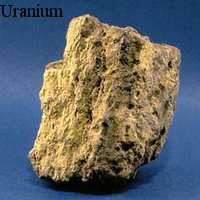
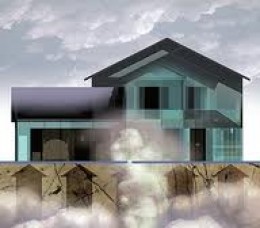
Uranium is a radioactive metallic chemical element found in soil, rocks, and ground and surface water. Radon is a radioactive gas that comes from the natural decay of Radium, and Radium is a decay product from Uranium.
There is no documentation of short term symptoms for exposure to Radon. If you are exposed to high radon levels, it will take years before noticing any kinds of symptoms.
You will not under any circumstances get symptoms such as headaches, joint pain, rashes, or stomach or sinus problems from exposure to Radon.
Over many years of exposure to high levels of Radon, your chances to get lung cancer will increase.
If you are a smoker, the risks will increase dramatically.
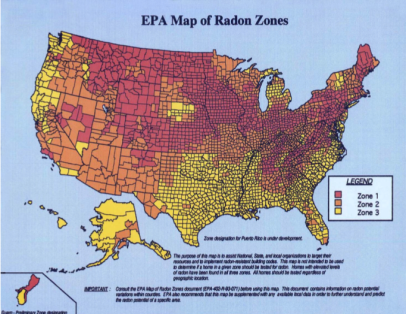
North Dakota and Western Minnesota is a Zone 1 area, which means an area with a higher possibility of elevated Radon levels. Around 50% of all houses in this area are likely to have dangerous levels of Radon.
Yes. Personally, I would never move into a home without knowing the Radon levels in the house. Since Radon levels fluctuate, not only from hour to hour, but also from year to year, the EPA recommends to test your house for Radon every 2-5 years.
No. There is really no logic to where the levels are too high. Your neighbor 15′ away could have an average of 22 Picocuries, while you could have 1, 9 Picocuries.
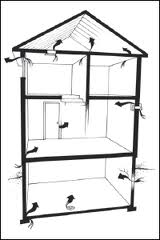 The EPA recommends to have all windows and doors closed at the minimum of 12 hours before the Radon testing starts. This is because Radon levels stabilize within about 12 hours, and
since Radon is radioactive, it is breaking down continuously. Let’s say you have a box with 1/2 pound of Radon, after 80 hours it will be down to 1/4, as the Radon will transform into other elements. (Like Lead, Bismuth, and Polonium).
After 80 more hours the box with Radon are likely to be empty.
Even though a home is closed up it will still breath, and there will be several air changes a day.
It is recommended to do the Radon test at the lowest living area in the house. If you spend only 15-20 minutes a day in your unfinished basement, it will be more interesting for you to know the results in a living area you spend most of your time. It is only recommended to do a Radon test in your unfinished basement if you are planning to make it a living area in the future.
The EPA recommends to have mitigation system installed if the levels are 4.0 Picocuries or higher, and to consider mitigation if the levels are between 2.0 and 3.9 Picocuries.
It will be up to each individual when to install a mitigation system, but the higher levels the higher risks.
Nothing. These numbers almost as low as it gets, and there should be no reason to do any mitigation, but test for Radon again within the next 2-5 years.
These levels are still low, but it would be optional to install a mitigation system as the chances for lung cancer have slightly increased from a number between 0 – 2.
With levels between 4 and 10 Picocuries it is recommended to install a mitigation system, as the chances to get lung cancer are now increased up to 8-9 times compared to having a Radon level of Picocuries.
It is strongly recommended to have a mitigation system installed with Radon levels higher than 10 Picocuries. 18 out of 1000 people will get lung cancer with 10 Picocuries, and 150 out 1000 if you are a smoker.
With 20 Picocuries 36 out 1000 will get lung cancer and 260 out of 1000 if you are a smoker.
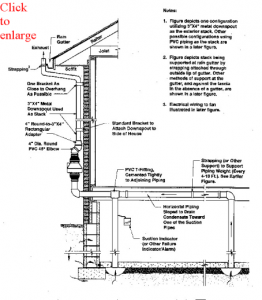 The most common mitigation system is a slab depressurization system. A fan will be installed either in the attic or outside the building, to draw air from below your concrete slab. If this is done correctly, the area below the slab becomes negative in pressure compared to the air above the slab. This will cause the airflow from the soil to reverse and go back to the soil, and effectively stop all infiltration of Radon to your house. If you have a crawlspace, a vapor barrier has to be installed to cover the crawlspace completely.
Depending on the type of structure and size of the house, a Radon mitigation system normally runs between $1000 to $1500.
As the Radon levels fluctuated not only hour by hour, but also from year to year, the EPA recommends to test your house every 2-5 years.
Having a Radon test professionally done will cost between $80 and $150.
Contact a couple of different local mitigation contractors; ask for references and an estimate. Install a Radon mitigation system in your home.