

Most people rarely think about their gas meter. Yet the meter and the regulator next to it sit outside all winter in snow, ice and spring meltwater. Good gas meter clearance, meaning open space around the meter and enough height above the ground, keeps that equipment working safely and lets the utility reach it quickly. Two of the most common gas meter findings during a home inspection are a meter set too close to the ground and shrubs or trees crowding the meter.
This guide explains what clearances utilities ask for, why they matter in a Red River Valley winter, what these findings mean in an inspection report, and simple ways to keep your meter clear all year.
Why gas meter clearance matters
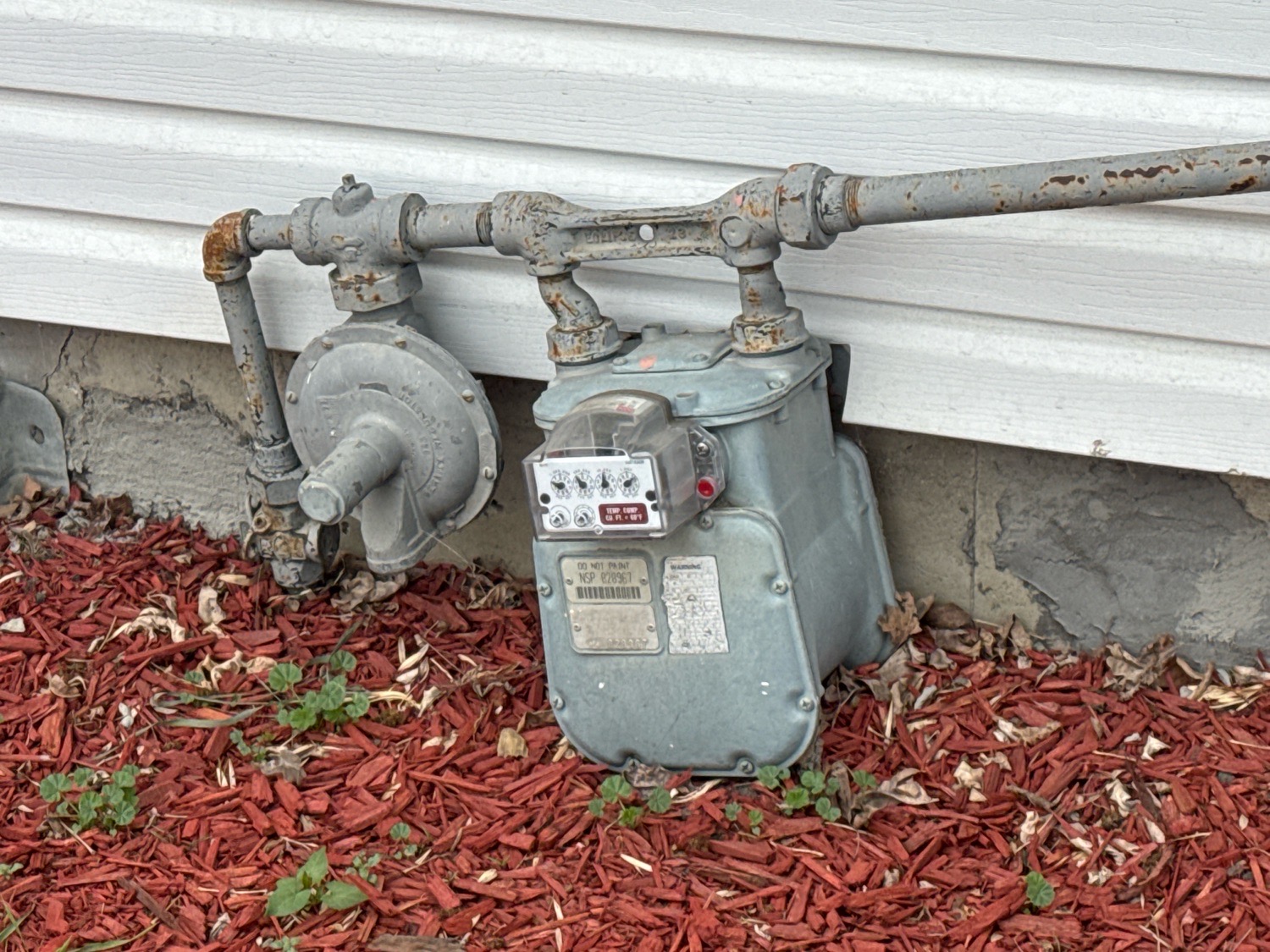
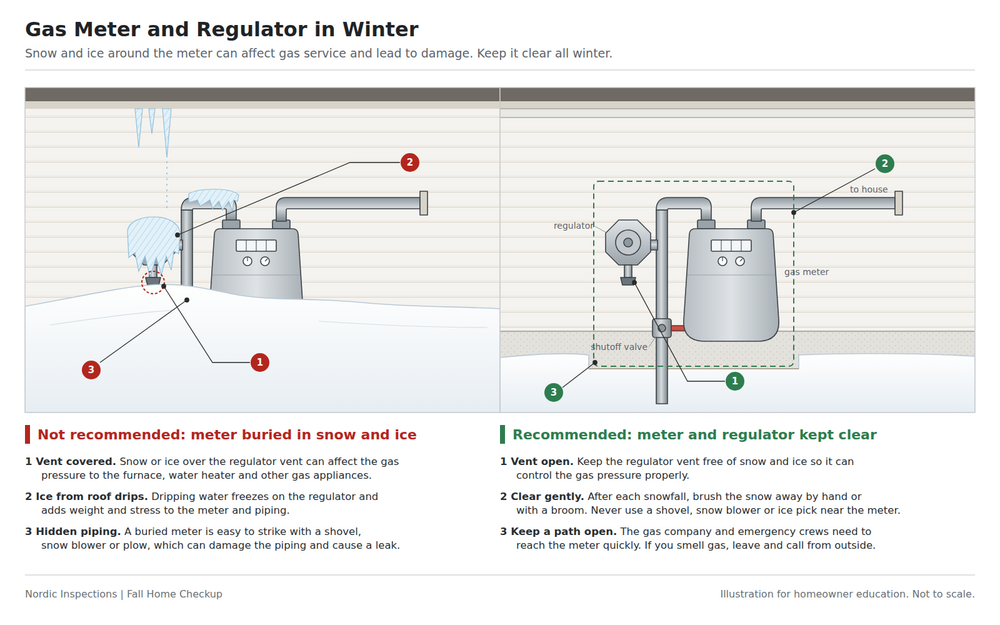
The gas meter measures how much natural gas the home uses. The regulator, the round dome-shaped part on the piping, lowers the pressure of the gas coming from the street to a level household appliances can use. The regulator has a small vent that lets it “breathe” as pressure changes. If that vent is buried or iced over, the regulator may not work as designed.
Clearance also matters for safety and service. A regulator can release a small amount of gas through its vent, so utilities want it kept away from windows, doors, air intakes and anything that could spark. In an emergency, the utility needs to reach the shutoff valve at the meter without digging through shrubs, snow or a deck.
Gas meter clearance requirements from local utilities
Each gas utility sets its own rules, and the details vary. In the Fargo-Moorhead area, the main utilities are Xcel Energy and Montana-Dakota Utilities. Here is what their published guidance says:
- Height above grade. Xcel Energy sets meters about six inches above final grade. That leaves room for small grade changes and landscaping without burying the meter piping.
- Space to work. Xcel Energy prefers at least 3 feet of working clearance around the meter. Montana-Dakota’s landscaping guidelines ask homeowners to leave at least 2 feet of clearance on the sides of the meter and 3 feet in front. Montana-Dakota’s meter location guidelines call for a 4-foot clear zone in front of the meter.
- Distance from openings and ignition sources. Xcel Energy keeps the meter and regulator at least 3 feet from doors, windows, vents and air intakes, and at least 3 feet from sources of ignition such as electrical switches and air conditioning units.
- No enclosures. Xcel Energy does not set meters under a deck or steps. Montana-Dakota asks homeowners not to enclose the meter in a deck, box or other structure.
- Protection from vehicles. Xcel Energy notes that meters within five feet of a driving surface need protection, such as concrete-filled steel posts called bollards.
Why winter makes it worse here
Fargo-Moorhead winters bring drifting snow, freeze-thaw cycles and ice dripping from roof edges. Each of these can bury or encase a gas meter. CenterPoint Energy warns that snow or ice from freezing and thawing can create safety problems when it blocks the regulator vent. Montana-Dakota adds that a buried regulator may become clogged.
Snow plowed or blown off a driveway often ends up piled against the side of the house, right where the meter sits. Ice from a gutter or roof edge above the meter can also build up on the regulator. Our post on winter hazards in your home covers other spots to check after a storm.
Signs a gas meter needs attention
Walk around the meter a few times a year and look for:
- Soil, mulch or rock built up so the meter or its piping is close to or touching the ground
- Shrubs, trees or tall plants growing into the space in front of or beside the meter
- Snow drifts, plowed snow or ice covering the meter or regulator
- Icicles or dripping water from the roof edge or gutter directly above the meter
- A deck, steps, fence or storage box built around the meter
- A meter that has settled or tilted, or piping that looks bent or stressed
What these findings mean in an inspection report
When we find a gas meter with too little clearance from the ground or vegetation crowding it, we note it in the inspection report and recommend correcting it. These findings are usually simple to fix, but a meter close to the soil can be buried by snow, ice or landscaping, and shrubs can block access in an emergency.
The fix depends on the cause. Trimming shrubs or pulling soil and mulch back is often enough. If the meter itself sits too low or in the wrong place, the gas utility decides what to do. The utility owns the meter and the piping up to it, and moving it is their job. The homeowner owns the gas piping from the meter outlet into the house.
Gas meter clearance is one of many items we check on the outside of a home during a home buyer’s inspection.
How to keep your gas meter clear
- Clear snow gently. Montana-Dakota recommends using a broom, not a snow blower or shovel, near the meter. Xcel Energy suggests clearing snow and ice gently, by hand.
- Don’t chip ice. Never kick or hit the meter or regulator to break off ice. If the meter is encased in ice, call your gas utility.
- Watch the roofline. Remove icicles above the meter safely and fix gutters or roof edges that drip onto it.
- Plan your landscaping. Don’t plant shrubs or trees in front of or near the meter, and keep soil and mulch below the meter piping.
- Keep snow piles away. When you clear the driveway, pile snow somewhere other than the side of the house where the meter is.
- Call before you dig. Call 811 before any digging so buried gas lines can be marked.
If you smell gas
Natural gas has an odorant added that smells like rotten eggs or sulfur. Some leaks have no smell, so don’t rely on your nose alone. If you smell gas inside or near your home:
- Leave the house right away. Don’t use light switches, phones or anything that could spark.
- Once you are safely away, call 911 and your gas utility. Xcel Energy’s gas emergency line is 800-895-2999. Montana-Dakota’s is 800-638-3278.
- Don’t go back inside until the utility says it is safe.
Leaks at the meter are more common than many people think. Our short post on gas leaks at the meter explains what we see in this area.
Gas meter clearance: common questions
How much clearance does a gas meter need?
It depends on the utility. Xcel Energy sets meters about six inches above final grade and prefers 3 feet of working space around the meter. Montana-Dakota asks for at least 2 feet on the sides and 3 feet in front, and its meter location guidelines call for a 4-foot clear zone in front. Your gas utility can tell you what applies to your home and whether a meter needs to be moved.
Can I plant shrubs around my gas meter?
Keep large plants away from the meter. Xcel Energy asks homeowners not to plant anything in front of or near meters. Low plants set back from the meter, outside the clearance zone, are less likely to cause a problem.
Who is responsible for the gas meter?
The gas utility owns and maintains the meter and the piping from the street to the meter. The homeowner owns the gas piping from the meter outlet to the appliances.
Sources
- Xcel Energy, Service Guide for Minnesota, North Dakota and South Dakota
- Xcel Energy, North Dakota Residential Natural Gas Service Agreement
- Xcel Energy, Minnesota New Mover Welcome Brochure
- Xcel Energy, Above-ground facility protection
- Montana-Dakota Utilities, Landscaping Guidelines
- Montana-Dakota Utilities, Gas Meter Location Guidelines
- Montana-Dakota Utilities, Keep Your Meter Clear
- CenterPoint Energy, Keep Your Natural Gas Meter Working Safely