

The Lennox Pulse furnace was a big step forward when it came out in 1982. It reached efficiencies above 90 percent at a time when many gas furnaces ran closer to 60 percent. Some are still running in older Fargo-Moorhead homes today. Because of a known history of heat exchanger corrosion, a Lennox Pulse furnace needs more attention than most furnaces, and the key step is a heat exchanger pressure test.
This guide explains how a Pulse furnace works, why the heat exchanger is a concern, what the pressure test involves, and what it means when this furnace shows up in an inspection report.
How a Lennox Pulse furnace works
Most gas furnaces burn a steady flame. A Pulse furnace works differently. A spark plug in a cast iron combustion chamber ignites tiny amounts of gas 60 to 70 times per second. Each small burst sends hot combustion gases through the heat exchangers.
This design pulled more than 90 percent of the heat out of the fuel. The exhaust leaves cool enough to vent through plastic PVC pipe. The furnace uses two heat exchangers, and moisture condenses out of the exhaust as it cools.
Why the heat exchanger is a concern
The heat exchanger keeps combustion gases separate from the air that circulates through the home. If it develops a rust hole or crack, those gases can leak into the house air. Combustion gases include carbon monoxide (CO), which you cannot see or smell and which can be deadly.
In 1997, Lennox announced an inspection program for Pulse furnaces in response to dealer reports of increased corrosion in some Pulse heat exchangers installed before 1990. Lennox urged owners of Pulse furnaces installed between 1982 and 1989 to schedule a furnace and safety check with an independent Lennox dealer. The program ran through July 1, 1999, and has since closed. It was a voluntary inspection program, not a government recall.
Age is the other concern. InterNACHI lists a typical furnace life of 15 to 25 years, and the U.S. Department of Energy gives 15 to 30 years. Any Pulse furnace installed in the 1980s is now well past that range.
How to tell if you have a Pulse furnace
- The name on the door. Lennox Pulse furnaces have “Pulse” on the front panel.
- The model number. Model numbers on the data plate begin with G14 or GSR14.
- The venting. The furnace vents through PVC plastic pipe rather than a metal flue into a chimney.
- Pulse 21. Units labeled Pulse 21 were made after 1990 and were not part of the 1997 inspection program. They are still pulse combustion furnaces and still need regular service.
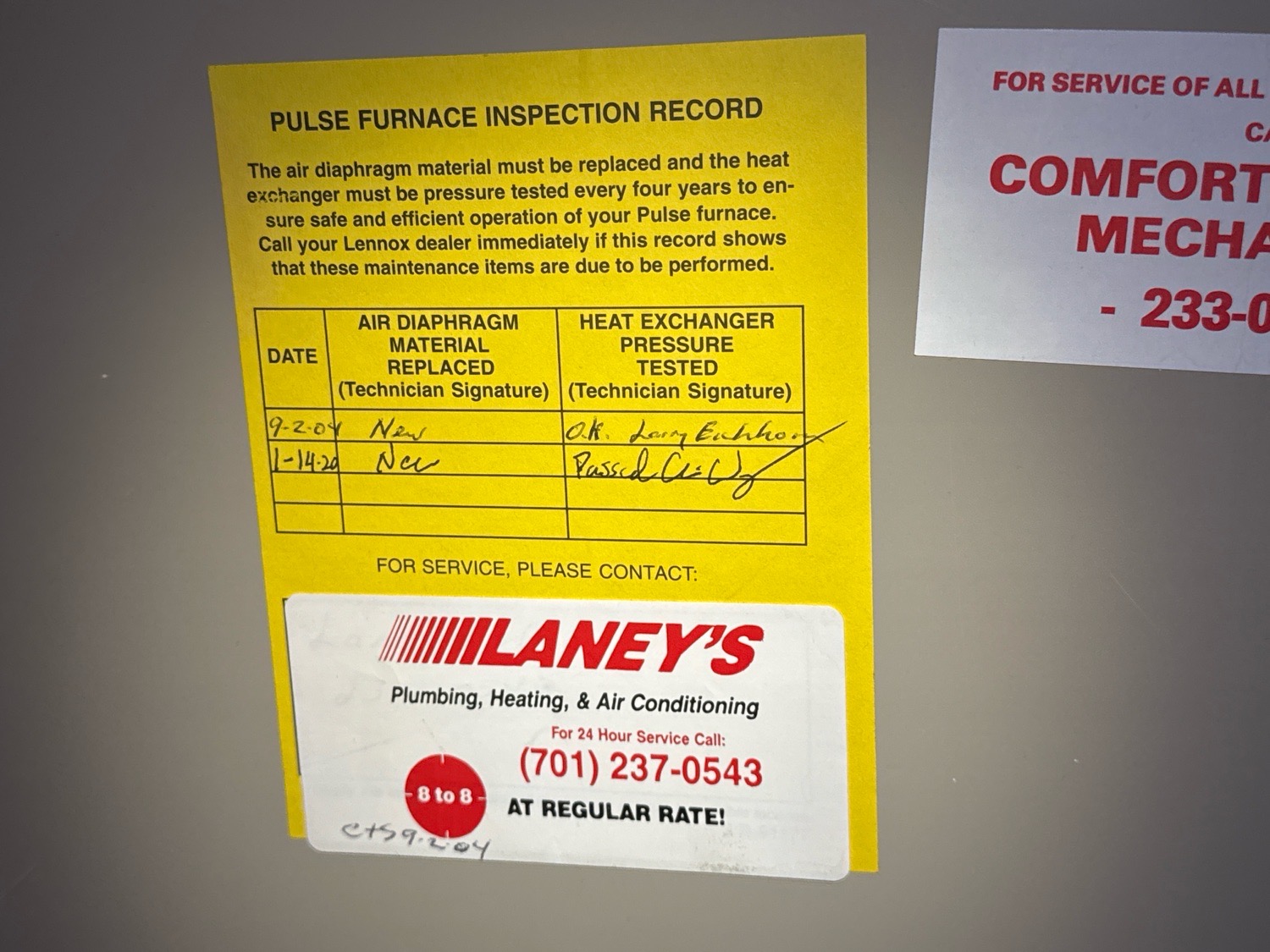
Look for a service sticker on the cabinet too. Many Pulse furnaces carry an inspection record where technicians log the date of each pressure test and air flapper replacement.
What the pressure test involves
A heat exchanger pressure test checks whether the sealed combustion side of the furnace can hold pressure. The technician plugs the heat exchanger assembly and pressurizes it. Under the procedure described for the Lennox program, a heat exchanger that cannot hold 4 psi for 10 minutes is considered leaky and could be unsafe.
The test is done along with regular maintenance. Lennox service guidance says the air flapper material must be replaced every four years regardless of how it looks. Many Pulse inspection records also call for a heat exchanger pressure test on the same four-year cycle. If a heat exchanger fails, the usual answer today is replacing the furnace, since these units are decades old.
What this finding means in an inspection report
When we find a Lennox Pulse furnace during an inspection, we look for evidence of a recent heat exchanger pressure test, usually a dated service record on the cabinet. If there is no evidence of a recent test, we recommend having the heat exchanger pressure tested by a qualified HVAC contractor before closing and having the furnace serviced every year. If the records show a recent test, we still recommend annual service because of the age of these furnaces.
A home inspection is visual. We cannot see inside a sealed heat exchanger, and a pressure test is a specialized check that an HVAC contractor performs. For a buyer, it is worth knowing before closing whether the furnace passes or will need to be replaced. A furnace this old may be near the end of its life either way, so it is wise to plan for replacement.
Heating equipment is one of the systems we check during a home buyer’s inspection. For homeowners, our Fall Home Checkup is a good time to look at the furnace before winter.
How to stay safe with an older furnace
- Install CO alarms. The U.S. Consumer Product Safety Commission recommends CO alarms on each level of the home and outside sleeping areas. Test them monthly and replace batteries every year.
- Schedule annual service. CPSC urges a yearly professional inspection of all fuel-burning heating systems.
- Keep records. Ask the technician to date and sign the service record on the furnace for each pressure test and flapper replacement.
- Know the symptoms. Early CO poisoning symptoms include headache, fatigue, shortness of breath, nausea and dizziness. They can feel like the flu without a fever. If a CO alarm sounds or several people feel sick at once, get everyone outside and call 911.
- Plan ahead. If your Pulse furnace is from the 1980s, start budgeting for a replacement before it fails in January.
Our post on frozen pipes in North Dakota explains why a furnace failure in winter can quickly become a plumbing problem too.
Lennox Pulse furnaces: common questions
Was there a recall on Lennox Pulse furnaces?
No government recall was issued. In 1997, Lennox announced a voluntary inspection program for Pulse furnaces installed between 1982 and 1989 because of heat exchanger corrosion. That program ended in 1999.
How often should a Lennox Pulse furnace be pressure tested?
Many Pulse inspection records call for a heat exchanger pressure test every four years, and Lennox service guidance calls for replacing the air flapper material every four years. Have the furnace serviced every year, and ask your HVAC contractor what interval they recommend for your unit.
Is it safe to keep using a Lennox Pulse furnace?
A Pulse furnace that passes a pressure test and is serviced regularly can keep running. Because Pulse furnaces from the 1980s are now 35 to 45 years old, working CO alarms and a plan for replacement are important.
How do I know if my furnace is a Pulse?
Look for “Pulse” on the front door and a model number starting with G14 or GSR14. Pulse furnaces vent through PVC pipe. Pulse 21 models were made after 1990.
Sources
- InspectApedia, Lennox Pulse Furnace Notice (reproduces Lennox’s 1997 announcement and service notes)
- MITSI, Lennox Pulse Furnace case study
- ACHR News, The 1990s: technological breakthroughs and higher efficiencies
- U.S. Consumer Product Safety Commission, Carbon Monoxide Alarms
- U.S. Consumer Product Safety Commission, CPSC Urges Annual Furnace Inspection
- InterNACHI, Standard Estimated Life Expectancy Chart for Homes
- U.S. Department of Energy, Home Heating Systems fact sheet