

Worried about mold in your home? Tell us about your concern and we’ll recommend the right next step.
If you are trying to sort through mold testing options, you have probably run into air tests, tape lifts, swabs, dust tests with names like ERMI, mycotoxin tests, mold-sniffing dogs and $15 kits from the hardware store. They don’t all answer the same question, and some don’t answer any useful question at all. This guide explains what each option can and can’t tell you, when testing is worth it, and when it isn’t.
Start with the question, not the test
The best mold test is the one that answers your specific question. Before choosing one, it helps to know what the leading public health agencies say about testing in general.
- The U.S. EPA says that “in most cases, if visible mold growth is present, sampling is unnecessary.” If you can see it, the next step is fixing the moisture and cleaning it up.
- The CDC goes further for homes: “CDC does not recommend mold testing.” Its reasoning is that no test can tell you whether a person will get sick, and there are no set standards for acceptable amounts of mold in a home.
- NIOSH, the federal workplace safety agency, says a thorough visual inspection and musty odors “are more reliable than air sampling” for finding dampness and mold problems.
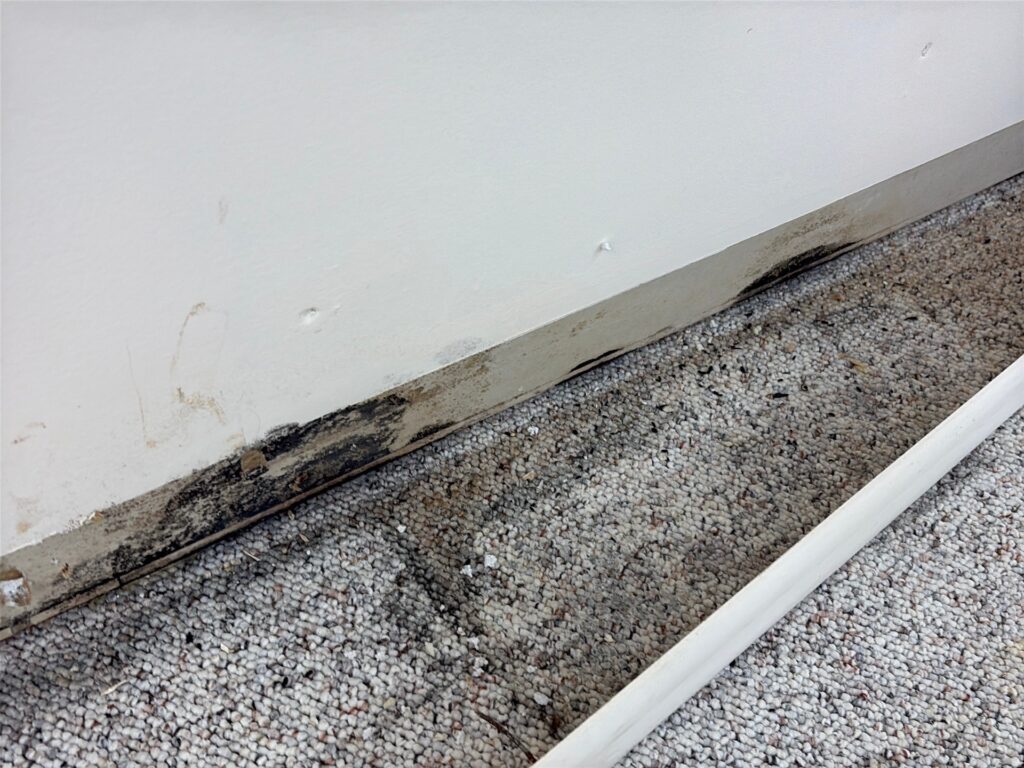
That doesn’t mean testing is useless. It means testing should have a purpose. Testing is most helpful when:
- You smell mold but can’t find it. A musty odor, a past leak or flood, or condensation problems suggest hidden growth inside walls, ceilings, crawlspaces or ductwork.
- Someone in the home is sensitive. People with asthma, allergies, weakened immune systems or a physician’s concern about mold exposure often want data, not guesses.
- Mold was cleaned up and you want proof it worked. The EPA notes that surface sampling can help check whether an area was adequately cleaned. After remediation, indoor mold types and levels should be similar to the outdoor air.
- You’re buying or selling a home and a visible stain, a past water problem or an odor raises questions.
- You need to tell mold from something else. Soot, dirt, efflorescence and staining can look like mold. A lab can tell the difference.
Moisture comes first
Mold needs water. Every mold investigation should begin with finding where moisture is coming from, because testing without fixing the moisture only measures a problem that will come back.
During a mold inspection, we look for water stains, condensation, plumbing and roof leaks, grading and downspout problems, and signs of past flooding. A moisture meter shows whether a stain is wet or dry today, and thermal imaging can reveal cold, damp areas inside walls and ceilings that you can’t see. Here in the Red River Valley, basements, spring snowmelt, high water tables and long heating seasons with winter condensation are the most common sources we trace.
Air sampling (spore trap)
What it is. A calibrated pump pulls a measured volume of air through a small sampling cassette. Spores and particles stick to a slide inside it. A laboratory then counts and identifies the spores under a microscope and reports them per cubic meter of air.
What it tells you. Air samples show what was floating in the air during the few minutes the pump ran, and how indoor air compares with outdoor air on the same day. When indoor levels are well above outdoor levels, or indoor air contains mold types that are rare outside, that points to an indoor source.
Its limits. The EPA notes that air sampling “provides information only for the moment when the sampling took place.” Spore levels rise and fall with activity, weather, the season and whether the furnace or air conditioner is running. NIOSH adds that short-term air samples, “especially negative findings,” may not represent actual exposure. A clean air sample does not prove that no mold is hidden in a wall.
Done right, air sampling always includes an outdoor comparison sample, and the samples are taken in more than one area of the home. We explain why in why mold sampling should include the whole home.
Surface samples: tape lifts, swabs and bulk samples
Surface samples answer a different question: “What is this growth on this surface?”
- Tape lift. Clear tape is pressed onto a suspect area and examined under a microscope. It is quick, inexpensive and good at confirming whether a stain is mold growth and which kinds are present.
- Swab. A sterile swab is wiped across the surface and sent to the lab, where it can be cultured. A culture grows the living mold so the lab can identify it, often down to the species. Results take longer, often a week or two.
- Bulk sample. A small piece of material, such as drywall, carpet or insulation, goes to the lab. This is useful when the growth is inside or behind a material.
Surface samples say nothing about the air in the rest of the home. They are most useful alongside a visual inspection and, when needed, air samples.
Dust tests: ERMI and HERTSMI-2
ERMI (Environmental Relative Moldiness Index) tests settled dust with a DNA method called qPCR. It was developed by EPA researcher Dr. Stephen Vesper and colleagues, who measured 36 mold species in dust from 1,096 U.S. homes to build a scale for comparing homes. HERTSMI-2 uses 5 of those species to create a score, and was created by Dr. Ritchie Shoemaker and colleagues to help judge whether a building is safe for people with mold-related illness.
What the experts say. ERMI was built as a research tool, and the agency that created it has never endorsed it for judging homes. The EPA states that it “does not recommend the routine public use of ERMI in homes” because the method “has not been validated for non-research purposes.” Its 2021 fact sheet adds that ERMI has not been validated through a multi-lab study, so the EPA can’t vouch for results from other laboratories. In 2013, the EPA’s Inspector General found that the test had not been validated for public use, that licensed labs were marketing it to the public anyway, and that an EPA webpage had suggested otherwise. The National Center for Healthy Housing put it plainly in 2012: ERMI “is not ready for prime-time as a home assessment tool.”
Limits we see in practice:
- The number moves around. In a 2014 study co-authored by EPA researchers, ERMI scores from two rooms in the same home differed by 10 points or more in about 1 in 5 homes, and repeat samples taken months apart differed widely in many homes.
- How the dust is collected changes the score. In the same study, the standard floor-dust sample averaged about twice the ERMI score of dust from the homeowner’s own vacuum bag. Many kits sold to homeowners use cloths or vacuum attachments that don’t match the research method.
- It compares your home to a national survey, not to homes in our climate or to your own outdoor air, and it counts only 36 mold species.
- Dust is a history book. Settled dust holds mold from years of living: old leaks that were fixed long ago, items brought in from elsewhere, and spores tracked in from outside. A score can’t tell you when the mold got there or whether the problem is still active.
- It doesn’t tell you where the mold is or where the water is coming from, which are the two things you need to know to fix it.
- It isn’t a health test. There are no health-based limits for mold. Higher scores have been linked to asthma in research studies, but a number can’t tell you whether your home is making someone sick.
HERTSMI-2 uses the same DNA test on 5 of the ERMI species, with a scoring system created by Dr. Ritchie Shoemaker for patients with chronic inflammatory response syndrome (CIRS). It shares all of ERMI’s sampling limits, and we are not aware of any government agency or professional standards body that has validated its scoring for judging homes.
Our experience. We regularly hear from homeowners who ordered an ERMI or HERTSMI-2 test, got a worrying score, and still had no idea where the mold was or what to fix. The number often adds stress without answers, and they end up needing an inspection anyway. If your physician has asked for one of these tests, follow that advice, but pair it with an inspection that finds the moisture source and the growth. We will cover both tests in depth in a separate post.
Mycotoxin testing
Mycotoxins are chemicals that some molds can produce. Mycotoxin testing comes in two very different forms, so it helps to know which one you are being offered.
Urine mycotoxin tests. These are sold directly to consumers and through some health practitioners. A urine sample is checked for mycotoxins such as ochratoxin and trichothecenes. In 2015, the CDC warned that urine mycotoxin tests “are not approved by FDA for accuracy or for clinical use,” that mycotoxins “are found in the urine of healthy persons,” and that levels that predict disease have not been established. A 2024 fact sheet from the Navy and Marine Corps Force Health Protection Command adds that no reference ranges have been set for healthy people. The American College of Medical Toxicology says diet is the most important source of mycotoxin exposure, through foods like grains, nuts, coffee and dried fruit. So a positive urine test doesn’t show that the mycotoxins came from your home.
Environmental mycotoxin tests. Some laboratories test settled dust, surfaces or building materials for mycotoxins. These tests can show whether certain mycotoxins are present in a sample from the home. Their limits are similar to ERMI: there are no exposure standards or accepted “safe” levels for mycotoxins in homes, and the American College of Medical Toxicology notes that finding a mold that can produce mycotoxins doesn’t mean the toxins are actually present.
Pros and cons of environmental mycotoxin testing:
- Pro: It can show whether specific mycotoxins are present in dust or a building material from the home.
- Pro: Some physicians who treat mold-sensitive patients ask for it, and it can add one more data point after water damage.
- Con: There are no exposure standards, so there is no accepted level that tells you a home is “safe” or “unsafe.”
- Con: Finding mycotoxins in a dust sample doesn’t show how much anyone actually breathes in. The American College of Medical Toxicology says mycotoxin levels in indoor and outdoor air are generally exceedingly low.
- Con: It doesn’t show where the mold is growing or where the moisture is coming from, so it can’t guide the repair.
Our take. If your physician asks for environmental mycotoxin testing, it can add information, but it should never be the only test. It doesn’t find the moisture source, and the result needs to be read alongside a full inspection. We will cover mycotoxins in more depth in a separate post.
DIY mold test kits (settle plates)
Most store-bought mold kits are settle plates: a petri dish of growth medium that you leave open in a room. Mold almost always grows on it, because mold spores are normal in every home and outdoors.
The University of Connecticut’s Environmental Health and Safety office explains why it does not recommend these kits. Spores are everywhere, so the dish will nearly always grow mold. The dish itself feeds mold, which gives a false impression of a mold problem. “There are no accepted standards” for running or reading these tests, and a dish can’t tell you where the spores came from.
A settle plate that grows mold tells you what you already knew: there are mold spores in the air, as there are everywhere. It doesn’t tell you whether you have a mold problem.
Mold-sniffing dogs
Mold detection dogs are growing in popularity. The dogs are trained to alert to the odors that growing mold gives off, and companies market them as a way to find hidden mold without opening walls.
What the research shows. The published evidence is thin. A 2007 study in the journal Sensors found that four trained dogs detected laboratory-grown mold samples about 75% of the time. That was a small study, using lab cultures rather than real homes, and the authors themselves described the method as still pending scientific validation. In Germany, the Federal Environment Agency reported in 2015 that a well-trained dog can recognize about 10 to 20 fungal and bacterial species and can help narrow down where hidden damage is. It also found there was no uniform training for mold dogs and set up independent testing of dog-and-handler teams for that reason.
Limitations you won’t hear in the sales pitch:
- A dog alerts to odor, not to mold. Odors travel through wall cavities, ductwork and floor systems, so the spot where a dog alerts isn’t always where the growth is.
- A dog can’t tell you what kind of mold it is, how much there is, or whether it is affecting the air you breathe. Those questions still need an inspection and lab analysis.
- There is little data on false alerts in real homes. The published studies are small and done with lab samples, so no one can tell you how often a dog misses mold or alerts to nothing.
- The result depends on the person reading the dog. The German Environment Agency calls it essential that the handler correctly reads and documents the dog’s reactions. A dog’s performance also depends on recent training, fatigue and conditions in the home.
- There is no independent U.S. certification standard. Mold dogs are often “certified” by the same company that trained them. New York State’s Toxic Mold Task Force recommended that certifying organizations be independent of any training provider.
The person holding the leash matters more than the dog. Many mold dog services are built around the dog, not the investigator. Training a dog to find an odor is not training in building science, moisture, sampling or lab interpretation. The American Industrial Hygiene Association says people who evaluate mold problems “should normally possess a certification awarded by a nationally recognized accreditation body,” and that investigators should be independent of the remediation contractor. When the handler isn’t qualified to investigate mold, there is no one to make sense of the alert, and homeowners are left with a “hit” and no plan.
Our take. A well-trained dog with a qualified investigator can be a useful pointer. On its own, an alert is a lead, not a result. Before anyone opens walls or you pay for remediation, an alert should be confirmed with moisture readings, a look inside the area, or lab sampling. If you are considering a mold dog, ask what credentials the handler holds for mold investigation (not just dog training), how the dog-and-handler team was independently tested, how they guard against false alerts, and whether the company also sells remediation.
Mold testing options at a glance
| Test | What it answers | Main limits | Best used when |
|---|---|---|---|
| Visual inspection with moisture meter and thermal imaging | Where is the moisture and growth? | Can’t see inside every wall | Always, first |
| Air sample (spore trap) with outdoor comparison | Is there more or different mold in the air than outside? | A snapshot of a few minutes | Musty odor, hidden mold suspected, sensitive occupants, after cleanup |
| Tape lift | Is this stain mold, and what kind? | Says nothing about the air | A visible spot needs confirming |
| Swab culture | Which living mold is growing here? | Slower results; living mold only | Species-level identification is needed |
| Bulk sample | Is the material itself contaminated? | Removes a small piece of material | Growth inside insulation, carpet or drywall |
| ERMI or HERTSMI-2 dust test | What mold DNA has built up in dust over time? | Not validated by the EPA for public use; no moisture source found | A physician asks for it |
| Urine mycotoxin test | Are mycotoxins in this person’s urine? | Not FDA-approved; found in healthy people; food is the main source | Not useful for judging a home |
| Environmental mycotoxin test (dust or material) | Are certain mycotoxins in this sample? | No exposure standards; no moisture source found | A physician asks for it, alongside an inspection |
| DIY settle plate | Not a useful question | Grows mold in almost every home | Not recommended |
| Mold-sniffing dog | Where might hidden mold be? | Limited research; no standard U.S. certification; can’t identify or measure mold | As a pointer, always confirmed by testing |
Not sure which test fits your situation? A preliminary mold inspection starts with the moisture and only samples where it answers a real question. Schedule a preliminary mold inspection.
What no mold test can tell you
No test can tell you whether the mold in a home is making a particular person sick. NIOSH puts it plainly: there are “no health-based standards for mold” in indoor air, and measured levels can’t be interpreted in relation to health risks. The EPA also notes there are no federal limits for mold or mold spores.
That’s why a good report doesn’t just list numbers. It explains what was found, where the moisture is coming from, and what to do next. If you have health concerns, share the results with your physician. Our mold health symptoms page is a good place to start.
How to choose who tests your home
The EPA recommends that sampling be done by professionals with specific experience in designing a sampling plan, collecting samples and interpreting the results. Before you hire anyone, ask:
- What certifications do you hold? Look for an indoor environmental credential from a recognized certifying body.
- Will you find the moisture source, or only collect samples?
- Do you take an outdoor comparison sample and sample more than one area?
- Which laboratory analyzes the samples, and will you explain the results in writing?
- Do you also sell the cleanup? A company that profits from remediation has a reason to find a problem. Many homeowners prefer an independent tester.
Our experience
At Nordic Inspections, mold inspections are led by Lars Knobloch, a Council-certified Indoor Environmentalist (CIE) through the American Council for Accredited Certification and an ASHI Certified Inspector. Lars is also a certified radon measurement professional and radon mitigation specialist, and has provided litigation support on building defects and environmental problems. Our inspectors are certified in thermal imaging. Nordic Inspections has served Fargo-Moorhead and the surrounding areas of North Dakota and Minnesota since 2010, and our mold samples are analyzed by EMSL Analytical, an independent laboratory.
Learn more about our mold inspection and testing services.
Mold testing options: common questions
Do I need a mold test if I can see mold?
Usually not. The EPA and CDC both say visible mold should be cleaned up and the moisture problem fixed, and you don’t need to know the type of mold to do that. Testing can still help when the area is large, when the source isn’t clear, when someone in the home is sensitive, or when you want to confirm that a cleanup worked.
Are home mold test kits accurate?
Settle-plate kits will grow mold in nearly every home, because mold spores are normal in indoor and outdoor air. They can’t tell you whether you have a mold problem or where it is. A professional inspection with outdoor comparison samples answers that question far better.
What is the best test for hidden mold?
There isn’t one test that finds all hidden mold. The most reliable approach combines a visual inspection, moisture readings and thermal imaging with air samples taken in several areas and compared with outdoor air. Where growth is suspected inside a wall or ceiling, the source of moisture usually points the way.
Can a mold test tell me if mold is making me sick?
No. There are no health-based standards for mold in indoor air, and test results can’t predict how a person will react. A physician should evaluate symptoms. A test can show whether a home has a mold problem that should be fixed.
Should I clean with bleach before testing?
No. Cleaning before testing can change the results. If you do clean visible mold yourself, read our guide on whether bleach and vinegar kill mold first.
Ready for real answers about mold in your home? Schedule a preliminary mold inspection. We’ll look for visible growth and trace the moisture behind it with moisture meters and thermal imaging, take samples only where they answer a real question, and explain the lab results in a written report with clear next steps.
Sources
- Mold Testing or Sampling, U.S. Environmental Protection Agency.
- Mold Course, Chapter 3: Mold Sampling Considered, U.S. Environmental Protection Agency (archived).
- About Mold, Centers for Disease Control and Prevention.
- Mold, Testing, and Remediation, National Institute for Occupational Safety and Health (NIOSH).
- ERMI fact sheet, U.S. Environmental Protection Agency, 2021.
- Public May Be Making Indoor Mold Cleanup Decisions Based on EPA Tool Developed Only for Research Applications, EPA Office of Inspector General, Report 13-P-0356, 2013.
- Development of an Environmental Relative Moldiness Index for US Homes, Vesper S.J. et al., Journal of Occupational and Environmental Medicine, 2007.
- Facts About DIY Mold Test Kits, University of Connecticut Environmental Health and Safety.
- Notes from the Field: Use of Unvalidated Urine Mycotoxin Tests for the Clinical Diagnosis of Illness, CDC, Morbidity and Mortality Weekly Report, 2015.
- Urine Mycotoxin Testing, Navy and Marine Corps Force Health Protection Command, 2024.
- Medical Toxicology Considerations in the Diagnosis and Treatment of Patients with Concerns About Mold-Related Inhalation Exposures, American College of Medical Toxicology position statement, 2025.
- Differentiation of Toxic Molds via Headspace SPME-GC/MS and Canine Detection, Griffith R.T. et al., Sensors, 2007.
- Good noses in search for mould: Use and training of mould detection dogs in Germany, German Environment Agency (Umweltbundesamt), 2015.
- Applicability of the Environmental Relative Moldiness Index for Quantification of Residential Mold Contamination in an Air Pollution Health Effects Study, Kamal A. et al., Journal of Environmental and Public Health, 2014.
- ERMI Data Used as a Predictor of Asthma, National Center for Healthy Housing, 2012.
- Position Statement on Mold and Dampness in the Built Environment, American Industrial Hygiene Association, 2013 (reviewed 2018).
- Final Report to the Governor and Legislature, New York State Toxic Mold Task Force, 2010.