
UV light systems are often marketed by heating and cooling contractors as a way to kill bacteria and mold spores inside HVAC systems. Homeowners are sometimes told that installing a UV light in the furnace return duct will clean the air, prevent mold, or improve health.
It is reasonable to question whether these systems are effective or whether they are oversold. Like many indoor air quality products, UV lights have specific uses and clear limitations.
What UV Light Is and How It Works
Most residential HVAC UV systems use ultraviolet C light. UV C has germicidal properties and has been used in controlled settings such as hospitals, laboratories, and water treatment facilities.
In those environments, UV light works because:
- The light intensity is high
- Exposure time is controlled
- Air or surfaces pass very close to the light source
- Conditions are designed around the technology
When UV C light damages the DNA or RNA of microorganisms, it can prevent them from reproducing.
How UV Lights Are Used in HVAC Systems
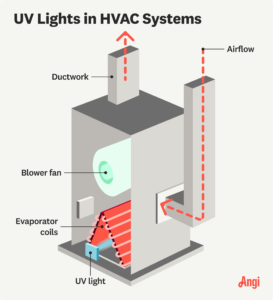
In residential HVAC systems, UV lights are typically installed in one of two places:
- Near the evaporator coil and drain pan
- In the return duct or supply duct
The most common residential application is near the cooling coil, where moisture is present and microbial growth can occur.
What UV Lights Can Realistically Do
UV lights can be effective at reducing microbial growth on surfaces that are directly exposed to the light for long periods.
In HVAC systems, this means:
- Limiting mold growth on evaporator coils
- Reducing biofilm on drain pans
- Helping keep certain components cleaner
This can improve system cleanliness and in some cases efficiency.
What UV Lights Do Not Do Well
The idea that a UV light in a return duct cleans the air throughout the home is often overstated.
There are important limitations:
- Air moves quickly through ducts
- Microorganisms have very short exposure times
- Light intensity decreases rapidly with distance
- Many spores are shielded by dust or duct surfaces
Because of this, UV lights are not very effective at killing airborne mold spores or bacteria as they pass through the system.
They also do not remove:
- Dust
- Allergens
- VOCs
- Odors
UV lights do not replace filtration or ventilation.
Are UV Lights Pseudoscience?
UV light itself is not pseudoscience, however confusion arises when we think about how broadly the benefits are applied in residential settings.
Claims that UV lights will:
- Clean all indoor air
- Eliminate mold problems in the home
- Resolve health symptoms
are not supported in typical residential HVAC installations.
When UV Lights May Make Sense
UV lights can be useful in specific situations, such as:
- Homes with recurring coil or drain pan mold growth
- Systems located in damp basements
- Homes where coil cleanliness is a known issue
Even in these cases, UV lights are a supplemental measure, not a primary solution.
What Matters More Than UV Lights
From a building perspective, the most effective ways to control indoor air quality and mold are:
- Proper humidity control
- Adequate ventilation
- Good filtration
- Addressing moisture sources
- Keeping HVAC systems maintained
If moisture is controlled, mold growth inside HVAC systems is far less likely to occur.
Safety and Maintenance Considerations
UV lights require ongoing maintenance. Bulbs degrade over time and must be replaced regularly to remain effective.
Improper installation can also create safety concerns, as UV C light can damage eyes and skin with direct exposure.
Final Thoughts
UV lights in furnace return ducts are not pseudoscience, but they are often oversold. They can help limit microbial growth on certain HVAC components when installed correctly and used for the right reasons.
They should not be viewed as a whole home air cleaning solution or a substitute for ventilation, filtration, and moisture control.
If you are considering a UV light system in your Fargo ND area home and want a clear explanation of whether it makes sense for your specific situation, Nordic Inspections is always available to help you understand what these systems can realistically do and what other steps may be more effective. Call us today at 701.566.1446 ext. 0