

An ERMI mold test or a HERTSMI-2 score can look like the most scientific answer available: a lab number based on mold DNA from the dust in your home. Many people order one after reading about it online, and some are asked to by their physician. But the number answers a narrower question than most people expect, and the agency that invented the method says it isn’t ready for routine use in homes. This post explains how both tests work, what the research and the experts say, and how to get real answers if you have one of these scores in hand.
Nordic Inspections · Fargo-Moorhead
Worried about mold in your home?
Tell us what you’re seeing or smelling and we’ll recommend the right next step. If you need one, a preliminary mold inspection finds the moisture and the growth, and only takes samples where they answer a real question.
Questions first? Call (701) 566-1446
Got an ERMI or HERTSMI-2 score? Start here
- Don’t tear anything out based on the number alone. A dust score shows mold DNA that built up over time, not where mold is growing today.
- Look for the water. Musty odors, past leaks, stains and window or basement condensation point to where hidden growth usually is.
- Share the full lab report with your physician if a physician asked for the test, together with what an inspection finds.
- Get the moisture and growth located before paying for remediation, so the cleanup targets the real problem.
What ERMI and HERTSMI-2 actually measure
Both tests start the same way. Dust is collected from the home, usually by vacuuming a measured area of carpet or wiping surfaces with a cloth, and sent to a lab. The lab uses a DNA method called mold-specific quantitative PCR (MSQPCR) to count the genetic material of specific mold species in that dust. The EPA developed and patented the method and has licensed it to commercial labs; the agency’s Inspector General counted 21 licensed companies between 2000 and 2013.
ERMI (Environmental Relative Moldiness Index) looks at 36 species. Twenty-six are “Group 1” molds associated with damp, water-damaged buildings, and 10 are “Group 2” molds common in most homes regardless of water damage. The score is the Group 1 total minus the Group 2 total, calculated on a log scale. The original national survey of 1,096 homes produced scores from about -10 to 20, and labs report where a home falls compared with those homes.
HERTSMI-2 (Health Effects Roster of Type-Specific Formers of Mycotoxins and Inflammagens, version 2) uses the same lab method but scores only five species: Aspergillus penicillioides, Aspergillus versicolor, Chaetomium globosum, Stachybotrys chartarum and Wallemia sebi. It was created by Dr. Ritchie Shoemaker, a physician known for his work on chronic inflammatory response syndrome (CIRS), to help his patients decide whether a building was safe for them to re-enter.
What the ERMI mold test was built for
ERMI was designed as a research tool, and it has done useful research work. EPA scientist Dr. Stephen Vesper and colleagues built the index from dust collected in HUD’s American Healthy Homes Survey, so researchers could compare the “moldiness” of homes on one national scale.
Studies have used it to look for links between moldy homes and health. In the Cincinnati Childhood Allergy and Air Pollution Study, 176 children were followed from infancy. Children who lived in a high-ERMI home (5.2 or above) at age 1 had about 2.6 times higher odds of having asthma at age 7, after adjusting for other factors. That is a real finding, and it supports what the World Health Organization and others have long said: damp, moldy homes are bad for respiratory health. But research compares large groups of homes; it doesn’t tell one family whether their home is safe.
What the EPA and other experts say about using ERMI in homes
The EPA has been unusually direct about its own tool. Its 2021 fact sheet says “EPA does not recommend the routine public use of ERMI in homes, schools, or other buildings,” because ERMI “has not been validated for non-research purposes” and has never been through a multi-lab study. In 2013 the EPA’s Inspector General found licensed firms using it with the public anyway and warned that people “may make inappropriate decisions regarding indoor mold.” The National Center for Healthy Housing put it plainly: ERMI “is not ready for prime-time as a home assessment tool.”
As far as we have found, no government agency or professional standards body has evaluated the HERTSMI-2 scoring system at all.
How HERTSMI-2 scores are read
Dr. Shoemaker’s guide calls scores under 10 “Safe,” 11 to 15 “Borderline; clean and re-test,” and over 15 “Dangerous for those with CIRS,” with an honest caution: “We cannot provide guarantees that HERTSMI-2 scores under 11 are safe.” The bands rest on a 2016 paper by Dr. Shoemaker and David Lark, posted on his Surviving Mold website, that compared 807 building tests from patient charts with whether patients relapsed. It reports more than 97 percent accuracy for low and high scores, but it lists no journal, had no control group and hasn’t been tested independently.
CIRS itself is not an established diagnosis in mainstream medicine, though many patients and their physicians take it seriously; we cover that debate in a separate post. HERTSMI-2 was built for one physician’s patients, not as a general home test.
Five problems with relying on a dust score
1. The score moves around. In a 2014 Detroit study of 112 homes, co-authored by EPA researchers, ERMI scores from two rooms in the same home differed by 10 points or more in about 1 in 5 homes. On a scale that runs roughly from -10 to 20, that is a large swing from one room to the next.
2. How the dust is collected changes the number. In the same study, the standard floor-dust sample produced ERMI scores nearly twice as high on average as dust from the family’s own vacuum bag. Lab instructions differ too. EMSL Analytical’s ERMI guide, for example, calls for vacuuming a 3-foot by 6-foot area of floor for 5 minutes in the living room and again in a bedroom. Cloth-wipe kits and vacuum-bag samples don’t match that method. Wonder Makers Environmental, a Michigan indoor environmental firm, warned in 2014 that people collecting cloth samples are “comparing the results to a table that was designed for samples collected using a different method.”
3. Dust is a history book. Settled dust collects mold from years of living, including leaks fixed long ago and spores tracked in from outside. A score can’t tell you when the mold got there or whether the problem is still active.
4. It doesn’t point to the problem. A high score doesn’t say which wall, ceiling or crawlspace has growth, or where the water is coming from. Those are the two things you need to know to fix it, and no score can tell you whether the home is affecting anyone’s health. We regularly talk with homeowners who received a worrying score and still had no idea what to repair, and most end up needing an inspection anyway.
5. Season and outdoor dust matter. Indoor environmental consultant Daniel Stih points out in his 2020 book Dust Money that a Finnish study found higher ERMI scores in winter, when fewer outdoor spores settle indoors with windows closed. In one of his cases, dust collected outdoors at a rural home also contained low levels of Stachybotrys and Wallemia, two of the molds people worry most about. A DNA test that looks for a needle in a haystack may find one; that doesn’t mean the source is inside the house.
One dust sample, two different verdicts
Here is what this looks like in practice. In 2015 we collected a standard ERMI dust sample from the carpet of a bonus room and the bedroom next to it, and EMSL Analytical ran the analysis. Below is the results page from that lab report, with nothing that identifies the home:
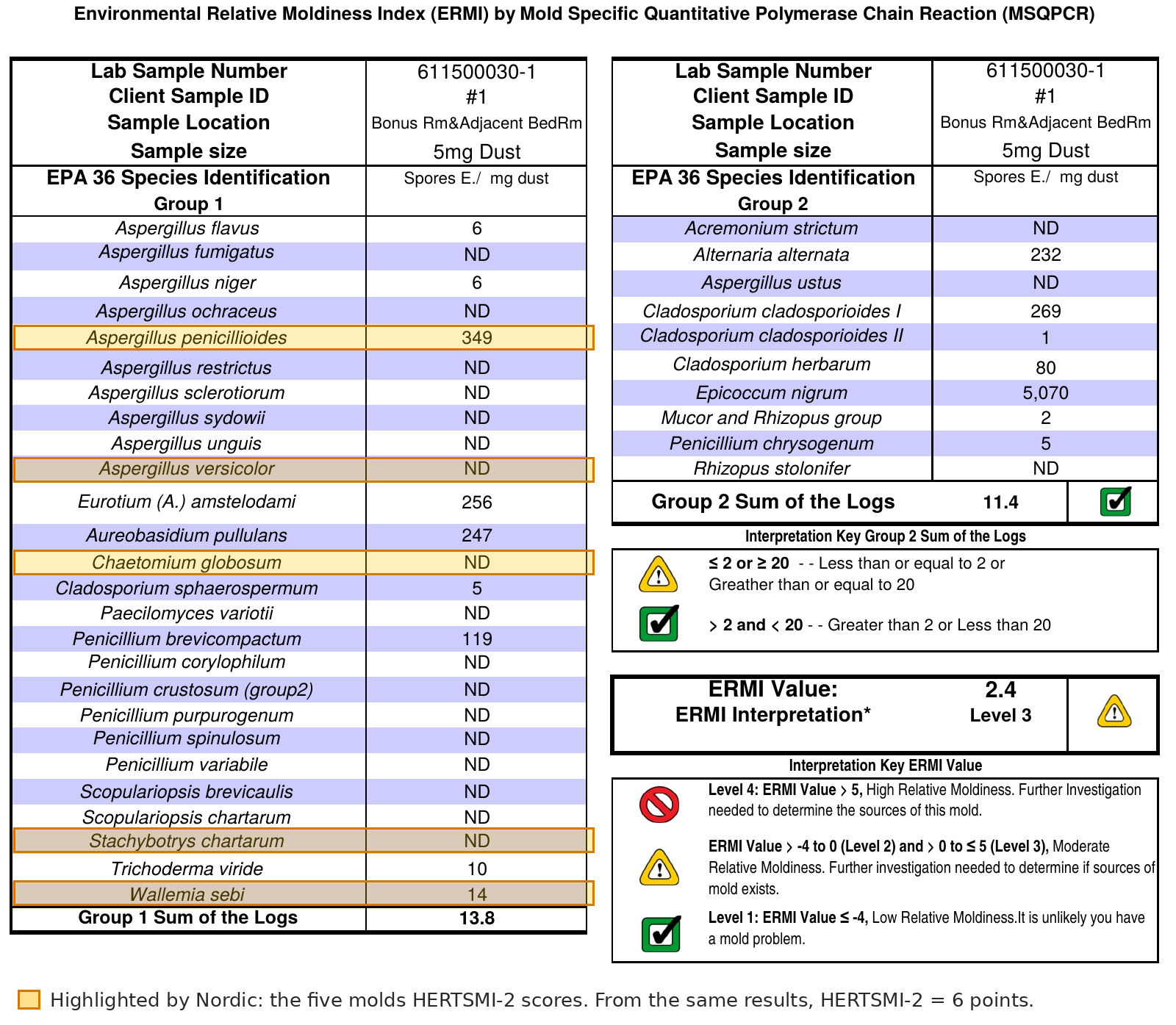
The same dust gets two different messages. The ERMI report says moderate moldiness and calls for more investigation. Scored with Dr. Shoemaker’s published HERTSMI-2 point table, the same numbers come out at 6 (only Aspergillus penicillioides, at 349, earns points), which his site describes as “statistically safe for re-entry for those with CIRS.” Neither number says where mold might be growing or whether there is a moisture problem.
The ERMI math has a quirk, too. Because the score is Group 1 minus Group 2, a lot of a common outdoor mold like Epicoccum pulls the score down. In our sample, Epicoccum nigrum, a common outdoor mold, was by far the largest result at 5,070. Wonder Makers Environmental showed the reverse problem with three real reports: the building with by far the most spores in its dust had the lowest ERMI score (1.53), while one with about 200 times fewer water-damage spores scored 4.4. As they put it, “the cleaner a home is made through remediation, the more difficult it may be to achieve an acceptable ERMI score.”
Got an ERMI or HERTSMI-2 score and no idea what to fix? A preliminary mold inspection finds the moisture and growth behind the number and only samples where it answers a real question. Schedule a preliminary mold inspection.
Why some doctors still ask for these tests
If these tests have so many limits, why are they popular? The answer comes mostly from clinicians who treat mold-sensitive patients, and their reasoning deserves a fair hearing.
Dr. Shoemaker argues that short air samples miss too much. In his 2016 paper he writes that spore traps fail because of “low sample volumes and the absence of the ability to microscopically determine the species of spores.” A 2016 consensus statement from a panel of indoor environmental professionals, published on his Surviving Mold website, describes dust collection as “the primary source of information regarding mold and mycotoxin production in the building,” because dust holds a record over a long period of time.
There is something to that. Air samples are a snapshot of a few minutes, and spore counts swing with weather and activity. Patients who react strongly to buildings understandably want a test that captures more than a single moment.
Here is the tension, and we want to be open about it. We take sensitive people seriously, and we respect physicians who are trying to protect them. But a dust score was never validated for deciding whether a particular home is safe, and in our experience it often adds worry without adding a plan. Both things can be true: a patient may benefit from extra caution, and the number still can’t tell anyone where the mold is or how to fix it.
If your physician asks for an ERMI or HERTSMI-2 test
If a physician has asked for one of these tests, follow that advice. A few practical steps make the result more useful:
- Use the lab’s own collection method. Follow the instructions from the lab that will run the sample, and note whether the sample was vacuumed or wiped. Collection method matters when comparing scores over time.
- Pair it with an inspection. A dust score should start a search, not end one. An inspection finds the moisture source and the growth so they can actually be fixed.
- Share everything with your physician. Bring the dust results and the inspection findings together, so health decisions are made with the full picture.
A better order of operations
The approach the EPA, CDC and NIOSH describe for homes starts with the building, not the lab:
- Find the moisture. Look for leaks, condensation, flooding history and grading or downspout problems. A moisture meter shows what is wet today, and thermal imaging can reveal cold, damp areas inside walls. In Red River Valley homes, basements and winter condensation are where we look first; we explain why in why mold grows in basements in Fargo homes.
- Look for growth. Visible growth and musty odors are often the most useful evidence.
- Sample with a purpose. Air samples with an outdoor comparison, tape lifts and swabs each answer a specific question. Air samples are a snapshot, so sampling works best alongside a careful inspection and in more than one area of the home.
- Fix the water, then clean up and verify. Remediation without a moisture fix doesn’t last. ERMI is a poor clearance test after cleanup: it was built to describe long-term conditions in homes, not to confirm that a recent remediation worked, and it was never designed for offices or schools.
For a side-by-side look at every test, from air samples to mold dogs, see our guide to mold testing options.
Our experience
At Nordic Inspections, mold inspections are led by Lars Knobloch, a Council-certified Indoor Environmentalist (CIE) through the American Council for Accredited Certification and an ASHI Certified Inspector. Lars is also a certified radon measurement professional and radon mitigation specialist, and has provided litigation support on building defects and environmental problems. Nordic Inspections has served Fargo-Moorhead and the surrounding areas of North Dakota and Minnesota since 2010, and our mold samples are analyzed by EMSL Analytical, an independent laboratory. Learn more about our mold inspection and testing services.
ERMI mold test: common questions
What is a good ERMI score?
There is no official “safe” score. Labs compare a home with the national survey homes the index was built on, and in one research study an ERMI of 5.2 or higher was treated as “high.” That is a research cutoff, not a health standard.
Does a low ERMI score mean my home has no mold problem?
No. A low dust score can miss growth hidden inside a wall, ceiling or crawlspace, especially if the dust sampled came from rooms away from the problem. An inspection that traces moisture is the better way to rule out hidden growth. We explain how in how to find out if mold is an issue in your home if you don’t see it.
Should I order an ERMI or HERTSMI-2 test before calling an inspector?
Usually not, unless your physician asks for one. Start with an inspection that finds the moisture and any growth. If a dust test is still needed afterward, it can be collected with that context in mind. Our mold health symptoms page is a good place to start if health is your main concern.
Sources
- ERMI fact sheet, U.S. Environmental Protection Agency, 2021.
- Environmental Relative Moldiness Index (ERMI), U.S. Environmental Protection Agency.
- Public May Be Making Indoor Mold Cleanup Decisions Based on EPA Tool Developed Only for Research Applications, EPA Office of Inspector General, Report 13-P-0356, 2013 (full report).
- Development of an Environmental Relative Moldiness Index for US Homes, Vesper S.J. et al., Journal of Occupational and Environmental Medicine, 2007.
- Blanc P.D., Vesper S.J. et al., Environmental Research, 2013 (describes the 26 Group 1 and 10 Group 2 molds and the ERMI calculation).
- High environmental relative moldiness index during infancy as a predictor of asthma at 7 years of age, Reponen T. et al., Annals of Allergy, Asthma & Immunology, 2011.
- Applicability of the Environmental Relative Moldiness Index for Quantification of Residential Mold Contamination in an Air Pollution Health Effects Study, Kamal A. et al., Journal of Environmental and Public Health, 2014.
- ERMI Data Used as a Predictor of Asthma, National Center for Healthy Housing, 2012.
- HERTSMI-2 and ERMI: Correlating Human Health Risk with Mold Specific qPCR in Water-Damaged Buildings, Shoemaker R.C. and Lark D., Surviving Mold, 2016.
- Got Mold? guide, Surviving Mold (Dr. Ritchie Shoemaker).
- Consensus statement of the Indoor Environmental Professionals Panel, Surviving Mold, 2016.
- ERMI/ARMI Sampling Guide, EMSL Analytical.
- WHO Guidelines for Indoor Air Quality: Dampness and Mould, World Health Organization, 2009.
- HERTSMI-2 scoring, Surviving Mold (Dr. Ritchie Shoemaker).
- A Quick Primer on the Perils of Using ERMI Samples for Post-Remediation Verification for Mold Projects, Wonder Makers Environmental, Information Series, 2014.
- Dust Money: How to Clean Your Home and Belongings After Mold Remediation, Daniel Stih, Healthy Living Spaces, 2020 (chapter “The ERMI Test,” pages 59 to 71).
- Mold Testing or Sampling, U.S. Environmental Protection Agency.