

Some of the most costly water damage we find starts at a piece of metal smaller than your hand. Kick-out flashing, the small angled diverter where a roof edge meets a wall, and the flashing above a garage door have the same job: send water out and away from the wall instead of into it. When either one is missing or installed wrong, water can soak the sheathing and framing for years before anything shows on the outside.
This guide explains what kick-out flashing and garage door flashing do, why they matter in Fargo-Moorhead, the warning signs, what these findings mean in an inspection report, and how they are fixed.
What kick-out flashing does
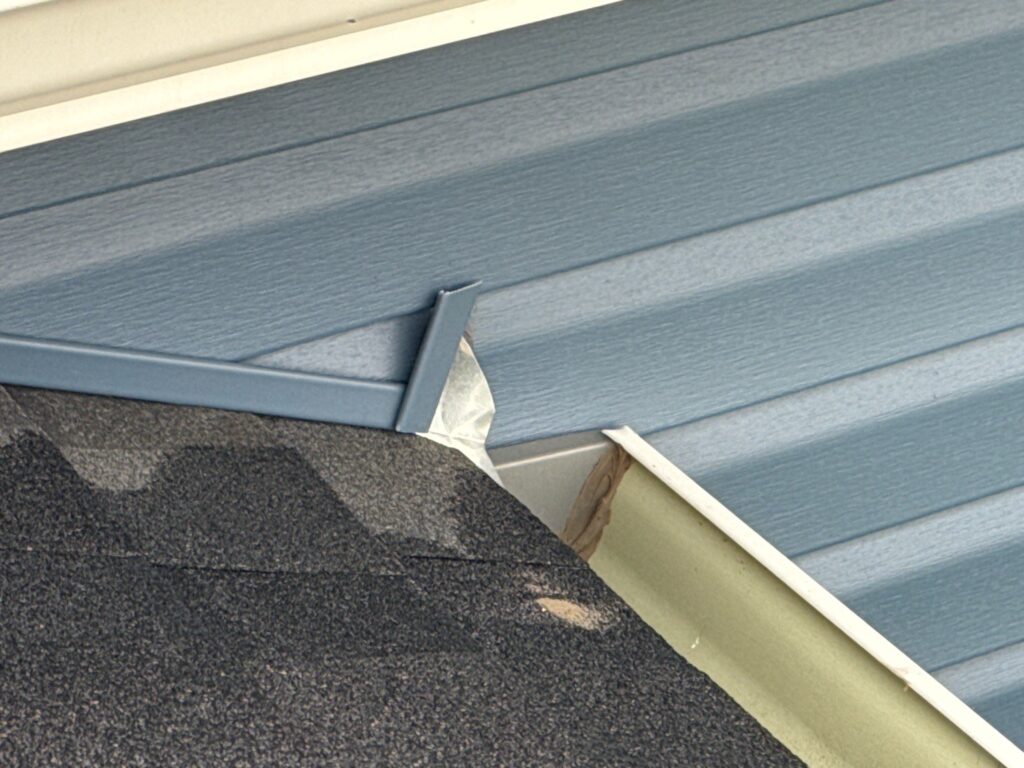
Where a lower roof runs into a taller wall, pieces of step flashing are woven into the shingles along the wall. At the bottom of that line, where the roof edge ends beside the wall, all the water running down the roof-wall joint has to go somewhere. A kick-out flashing, also called a diverter, is a short, angled piece that turns that water out into the gutter.

Without one, water running down the joint can get behind the siding at the bottom corner, right where the gutter ends. InterNACHI notes that this kind of damage can be serious even when little or nothing shows on the surface. Common spots are garage, porch and entry roofs that butt into a taller wall, dormers, and the sides of chimneys where a gutter ends.
Kick-out flashing is required by code
Kick-out flashing is not an upgrade. The Minnesota Residential Code, which applies in Moorhead, states that “a kick-out flashing shall be installed to divert the water away from where the eave of a sloped roof intersects a vertical sidewall.” The part on the roof must be at least 2-1/2 inches long, and metal flashing must be corrosion-resistant and at least 0.019 inch thick (No. 26 galvanized sheet). Minnesota also requires kick-out flashing when an existing home is re-sided, though not for a re-roof alone.
The International Residential Code, the model code Fargo enforces in its 2024 edition, has called for kick-out flashing at these spots since its 2009 edition. Many older homes were built without kick-outs, but one is still the best protection for that wall.
Flashing above garage doors
A garage door is usually the widest opening in the house. All the water running down the siding above it lands on the top of the door trim. The residential code calls for flashing at the head of exterior door openings and above projecting wood trim. In practice that means a head flashing, often a Z-shaped piece of metal, tucked up under the siding and the water-resistive barrier (house wrap) above, with a lip that runs out over the trim so water drips clear.
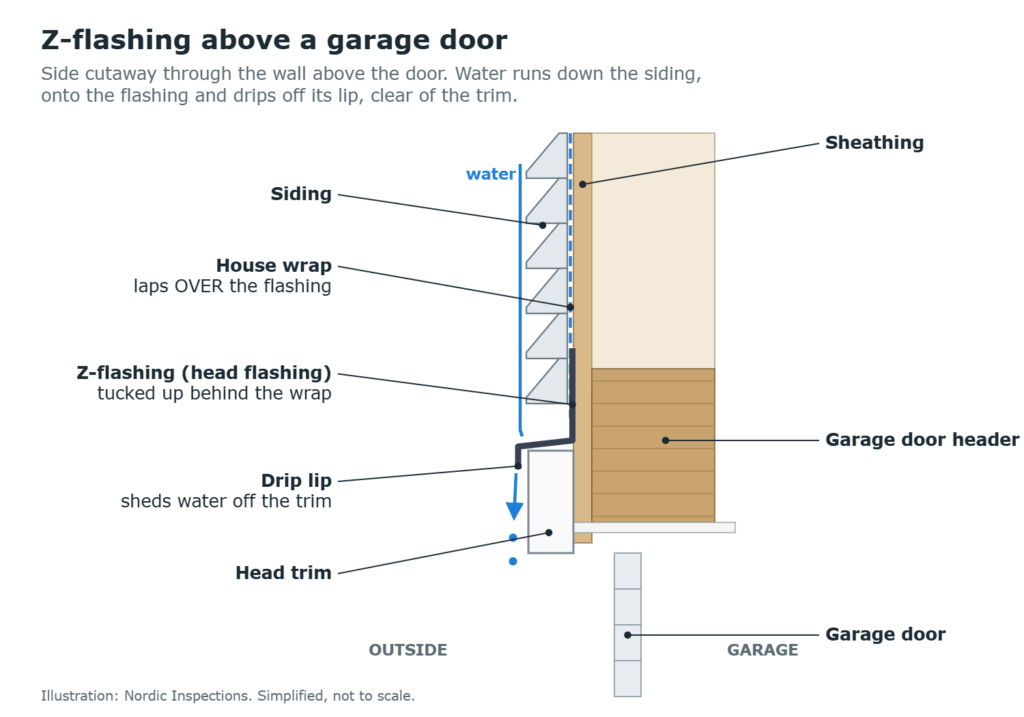
Common problems are flashing that is missing, flashing laid on top of the house wrap instead of under it, and flashing bent flat or sloped back toward the wall. Water then soaks the trim, the header and the framing around the door. In one case described in the Journal of Light Construction, a complete lack of flashing over garage doors led to rot in the header and framing on more than 300 houses.

Metal trim wrap can hide the problem. The same article notes that capping over wood “traps water and doesn’t allow the wood beneath it to dry.”
Why it matters in Fargo-Moorhead
Spring snowmelt, heavy summer storms and wind-driven rain all send water down roof-wall joints and over garage door trim, and snow on a lower roof can melt against a wall for days. Our post on ice dams in Fargo-Moorhead homes covers that side of the problem.
Wood rots when it stays wet. LSU AgCenter’s guide to wood decay notes that most rot-causing fungi will not attack wood kept below 20 percent moisture content. A wall section soaked every spring and after every storm can stay above that level. InterNACHI also notes that today’s better-insulated, wrapped walls dry more slowly, which makes good flashing even more important.
Warning signs to look for
- Streaks, stains or peeling paint on the siding below the end of a roof-wall joint.
- Soft, swollen or cracked siding or trim at the bottom corner where a lower roof meets a wall.
- A kick-out that has been shortened or cut flush with the wall to make it less visible.
- Peeling paint, soft wood or gaps along the top of the garage door trim.
- Loose or bulging trim wrap, or caulk used in place of flashing above the door.
No stain does not mean no damage. Water can be trapped inside a wall without showing on the surface.
What it means in an inspection report
When we find missing or too-short kick-out flashing, or missing or improperly installed flashing above a garage door during an inspection, we note the location and recommend correction by a qualified roofing or siding contractor. If there is no visible damage, it is a prevention item, and fixing it now is far simpler than repairing rotted sheathing later.
When we see wood rot, soft spots or staining, we also recommend repair of the damaged materials. A visual inspection cannot see inside the wall, so the contractor may find more damage once the siding or trim is opened up.
How kick-out and garage door flashing are fixed
Kick-out flashing. A proper retrofit means removing siding at the bottom of the roof-wall joint, installing a one-piece, leak-free diverter and lapping it correctly with the step flashing and house wrap, then reinstalling the siding. The Department of Energy’s Building America Solution Center advises against simply cutting a slot in the siding and sliding a diverter in, since it will not tie into the flashing or house wrap behind. InterNACHI notes that the diverter angle should be at least 110 degrees, and that its height should match the sidewall flashing, typically 6 inches. The gutter should run close to the wall so the diverted water has somewhere to go.
Garage door head flashing. The siding and trim above the door are removed as needed, the head flashing is installed with the house wrap lapped over its upper leg like shingles, and the outer lip is set to drip clear of the trim. Any rotted trim, sheathing or header wood is replaced first.
Simple checks you can do
- Walk around the house each spring and fall and look at every spot where a lower roof meets a wall.
- Look up at the top of each garage door trim for gaps, peeling paint or soft wood.
- Keep gutters clean so diverted water reaches the downspouts. Our post on clogged and leaking gutters in Fargo-Moorhead has tips.
- If you are re-siding, ask your contractor to add or correct kick-out and head flashing.
For a full seasonal list, see our fall home maintenance checklist.
Kick-out flashing: common questions
What is kick-out flashing?
A small, angled flashing at the bottom of a roof-wall joint that turns water into the gutter instead of down the wall.
My home is older and has no kick-out. Do I need one?
Older homes were often built without them. Minnesota requires one when a home is re-sided, and adding one is a good idea any time the siding at that spot is removed or shows water damage.
Can I just caulk the gap instead?
No. Caulk can seal small joints, but it does not redirect water. It also cracks with time and freeze-thaw cycles, while a properly lapped flashing keeps working.
How can I tell if water has already gotten into the wall?
Look for stains, soft or swollen wood and peeling paint below the problem area, inside and out. A moisture meter can help, but opening the wall is often the only way to know how far damage goes.
Sources
- InterNACHI. Kickout Flashing.
- U.S. Department of Energy, Building America Solution Center. Step and Kick-Out Flashing at Roof-Wall Intersections.
- Minnesota Rules, part 1309.0903. Section R903, Weather Protection (kick-out flashing).
- Minnesota Rules, part 1309.0703. Section R703, Exterior Covering (flashing at door openings).
- City of Fargo. Current Codes.
- Journal of Light Construction. Garage Door Flashing Failures.
- LSU AgCenter (via USDA Forest Service). Causes and Control of Wood Decay, Degradation and Stain.