

If you own a stucco home, you will see stucco cracks sooner or later. Most are thin hairline cracks that come with the material. Some are a sign of movement or water getting behind the wall. Knowing the difference helps you decide when a tube of sealant is enough and when to call a plasterer.
This guide explains why stucco cracks, which cracks matter, how cracks are repaired, what these findings mean in an inspection report, and how to protect a stucco wall in our climate.
Why stucco cracks
Traditional stucco, also called portland cement plaster, is a thin, hard layer of cement plaster over wire lath. It is strong but brittle, and the house behind it moves. Wood framing and sheathing shrink and swell, the house settles, and temperature changes make the plaster expand and contract. When the stress is more than the plaster can take, it cracks.
That is why cracks are expected. Building Science Corporation, after studying stucco walls in the field, concluded that “it is not possible to construct stucco assemblies without cracks.” A Sika technical bulletin quotes the Stucco Manufacturers Association: minor cracking at corners “is reasonable and should be anticipated.”
Common causes include:
- Shrinkage of the plaster as it cures.
- Framing that shrinks or twists as it dries.
- Settling or movement of the foundation.
- Too few control joints, or joints in the wrong places.
- Stress at the corners of windows and doors.
Our freeze-thaw seasons add one more concern. Water that gets into a crack can freeze and expand, and a long winter gives a small crack many chances to take on water.
Stucco cracks: which ones matter
Hairline cracks. Fine cracks in the finish coat, often in a spiderweb or map pattern, are the most common type. Sika’s repair bulletin treats cracks up to about 1/32 inch as hairline. They are mostly cosmetic, though many cracks close together can still let water soak into the wall.
Corner cracks. Diagonal cracks running from the corners of windows and doors are very common, because stress concentrates there. They are worth sealing, since they sit right where water runs off the window.
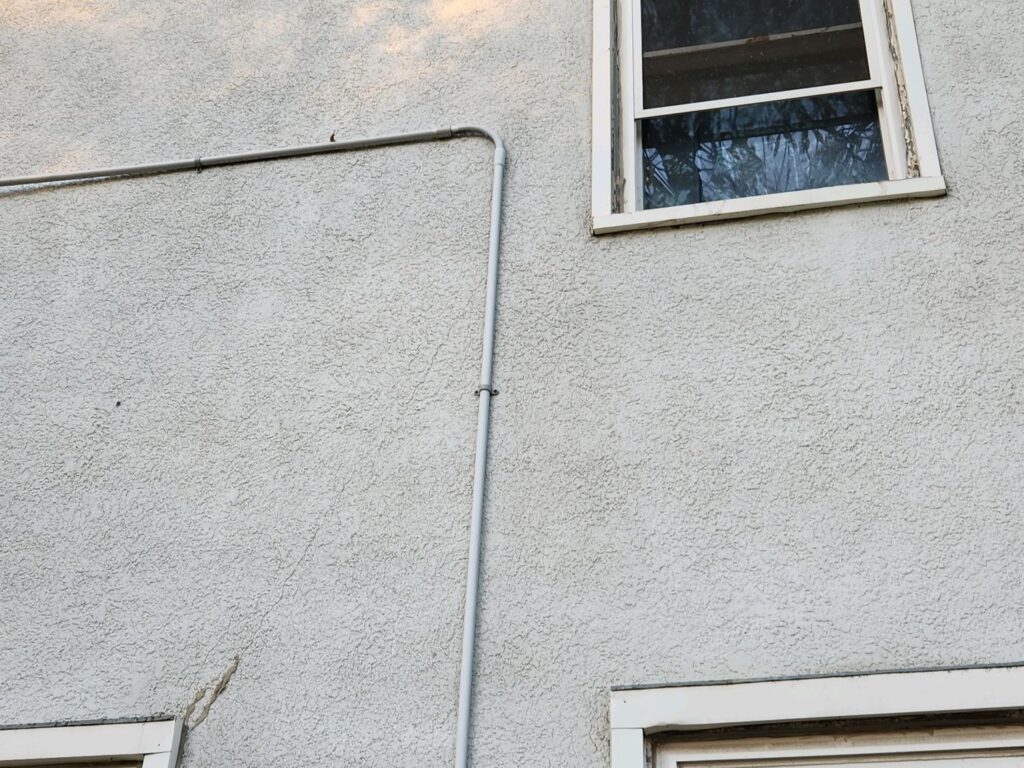
Wider cracks. Cracks wider than about 1/16 inch, cracks that grow over time, and cracks where one side sits higher or farther out than the other point to movement, not just shrinkage. Long cracks that line up with cracks in the foundation can be related to settling. Our post on why foundations move in Fargo-Moorhead explains why that happens on our clay soils.
Damage near the ground. Crumbling, soft or stained stucco along the bottom of the wall is often a moisture problem. Minnesota’s residential code requires a weep screed, a metal or plastic strip that lets water drain out at the bottom of the stucco, at least 4 inches above soil or 2 inches above paved areas. When soil, mulch or a patio covers that edge, water has nowhere to go.

Why water behind stucco is the real concern
A crack in the plaster is rarely the problem by itself. The bigger risk is the wood behind it. Over wood framing, stucco depends on a drainage layer, a water-resistive barrier behind the plaster that carries water down and out. Minnesota’s code calls for two layers of that barrier over wood-based sheathing, unless a drainage gap is built in. The Journal of Light Construction explains why: stucco tends to bond to the first layer, and the second layer keeps a path open for water to drain.
When cracks, missing flashing or poor details let in more water than the wall can drain, the sheathing and framing can stay wet and rot without much showing on the outside. Our post on kick-out flashing and garage door flashing covers two of the most common places this starts.
Warning signs of hidden moisture include:
- Stains or streaks running down from window corners or the ends of roof lines.
- Bulging, soft or hollow-sounding areas of stucco.
- Cracks that keep coming back after repair.
- Crumbling or stained stucco near the bottom of the wall.
- Stains, musty odors or soft drywall inside, below windows on stucco walls.
What it means in an inspection report
When we find stucco cracks during an inspection, we note their location and type. For typical small cracks, we recommend sealing them with a flexible acrylic or elastomeric product made for stucco, or having a plastering contractor repair them, to keep water out. Previously repaired cracks are noted too, so the next owner can monitor them and re-seal as needed.
When we see wider cracks, damage near the ground, buried weep screed or signs of moisture, we recommend further evaluation by a qualified stucco contractor. A visual inspection cannot see behind the plaster, and moisture testing or a closer look may be needed to know whether the wall behind it is wet.
How stucco cracks are repaired
The right repair depends on the size of the crack and whether it is still moving. Manufacturer guidance from Sika lays out a typical approach:
- Hairline cracks (up to about 1/32 inch): an elastomeric coating over the area, usually two coats, which bridges small cracks and can be applied to a whole wall for an even look.
- Small cracks (about 1/32 to 1/16 inch): filled with a patching compound, or covered with mesh embedded in a base coat for a few isolated cracks, then coated or refinished.
- Larger, stable cracks (about 1/16 to 1/4 inch): routed out to an even width, filled in layers, then coated or resurfaced.
Many homeowners seal small cracks with a flexible acrylic sealant made for stucco, which keeps water out and moves with the wall. A Journal of Light Construction article by an experienced plasterer notes the trade-off: some caulk and acrylic patches look fine when dry but show up when the wall is wet, because stucco darkens with water and the patch does not. If appearance matters, a plasterer can blend the repair with matching material.
Cracks that are still moving, or that come with bulging, rot or settling, need the cause fixed first. Patching over an active problem only hides it.
How to protect a stucco wall
- Walk around the house each spring and fall and look for new or growing cracks. A dated photo makes changes easy to spot.
- Seal small cracks before winter so water cannot get in and freeze.
- Keep soil and mulch below the bottom edge of the stucco, and keep the ground sloping away from the house. See Lars Knows: Good Grade.
- Keep gutters and downspouts working so roof water does not run down the walls. Our post on clogged and leaking gutters in Fargo-Moorhead has tips.
- Check caulk around windows, doors and wall penetrations, and re-seal where it has cracked or pulled away.
Stucco cracks: common questions
Are cracks in stucco normal?
Yes, fine hairline cracks are expected in cement stucco and are usually cosmetic. Wider, growing or offset cracks deserve a closer look.
How wide is too wide?
Repair guidance treats cracks up to about 1/32 inch as hairline. Cracks over about 1/16 inch, or cracks that keep growing, call for a proper repair and a look at the cause.
Can I fix stucco cracks myself?
Small, stable cracks can often be sealed with a flexible acrylic or elastomeric product made for stucco. Larger cracks, repeated cracking and any sign of moisture damage are best handled by a plastering contractor.
Should I paint over cracks?
Ordinary paint will not bridge cracks. Elastomeric coatings are made to stretch over hairline cracks, but larger cracks should be repaired first.
Do stucco cracks mean the foundation is failing?
Usually not. Most come from shrinkage and normal movement. Long cracks that line up with foundation cracks, or that keep growing, are worth having evaluated.
Sources
- Sika Corporation. Procedures for Repairing Stucco (technical bulletin).
- Sika Corporation. Cracks in Cement Plaster (Stucco) (technical bulletin).
- Journal of Light Construction. Stucco That Works.
- Journal of Light Construction. Fixing Hairline Stucco Cracks.
- Walls & Ceilings. Cracks in Portland Cement Plaster (Stucco).
- Minnesota Rules, part 1309.0703. Section R703, Exterior Covering (stucco, weep screed and water-resistive barrier).