

Siding gets all the attention, but it is not what keeps rain out of your walls. Behind vinyl, steel, fiber cement, wood or stone veneer there should be a thin layer called a weather resistant barrier. It is the wall’s last line of defense against water that gets past the siding, and every siding type lets some water past. When we find no weather resistant barrier, or a torn or damaged one, during a home inspection, it is worth understanding why it matters and what to do next.
This guide explains what a weather resistant barrier is, why siding alone is not enough in the Red River Valley, the signs of a missing barrier, what the finding means in an inspection report and how it is fixed.
What is a weather resistant barrier?
A weather resistant barrier, also called a water-resistive barrier or WRB, is a sheet or coating installed over the wall sheathing before the siding goes on. Common types include house wrap, asphalt-saturated felt (tar paper) and sheathing panels or liquid coatings designed to act as the barrier themselves.
Its job is simple. Water that gets behind the siding runs down the face of the barrier instead of soaking into the wood sheathing and framing. At the bottom of the wall it drains back out. Builders call this a drainage plane.
The International Residential Code, which North Dakota and Minnesota base their building codes on, requires at least one layer of water-resistive barrier over the studs or sheathing of exterior walls. When felt or house wrap is used, the upper layer must lap over the lower one by at least 2 inches, and vertical joints must lap at least 6 inches, so water always flows over a seam, never into it.
Why siding alone is not enough
Many people think of siding as waterproof. It isn’t. The vinyl siding industry says it plainly: vinyl, insulated and polypropylene siding are exterior claddings, not water-resistive barriers. Siding is designed to shed most of the rain and let the wall behind it breathe. It works like a rain screen that reduces the water reaching the barrier underneath.
Water still gets behind siding at laps, joints, corners, nail holes, and around windows, doors, vents and light fixtures. Here in Fargo-Moorhead, strong winds drive rain sideways into those joints, and snow piled against walls melts in spring. Without a barrier, that water reaches the sheathing directly. Over time, wet sheathing can rot, rust fasteners, grow mold inside the wall and let water into the house.
Because the damage happens out of sight, it often goes unnoticed for years. By the time stains show up inside, the repair is usually bigger than it would have been.
Signs of a missing or damaged barrier
You usually can’t see the barrier on a finished house. It shows up where siding stops short, has been removed or is damaged. Look for:
- Bare wood sheathing or framing showing where siding is missing, cracked or loose
- No house wrap or felt visible behind siding at the bottom of walls, under decks or at gaps around trim
- Torn, flapping or sun-damaged house wrap
- Wrap that is lapped the wrong way, with lower sheets over upper ones
- Water stains, soft spots or rot on sheathing or trim
- Peeling paint, stains or damp drywall on the inside of exterior walls, especially below windows
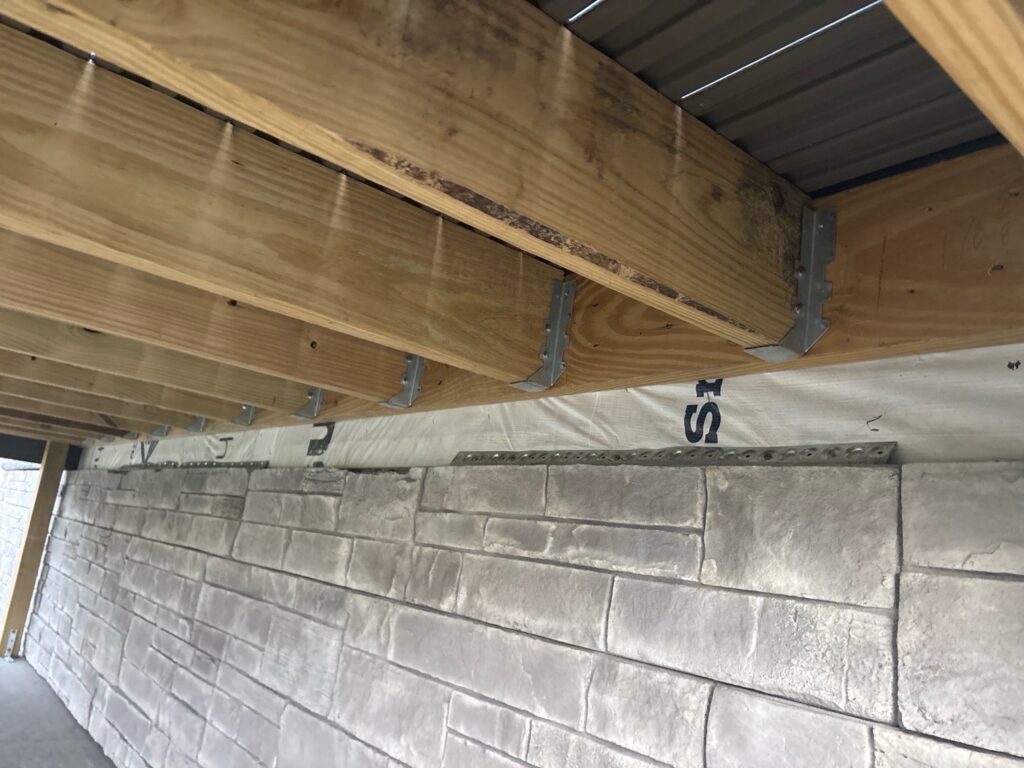
Areas under decks, behind downspouts and where siding was patched are common trouble spots. Our post on kick-out flashing and garage door flashing covers two of the places where water most often gets behind siding.
What this finding means in an inspection report
An inspector can only look where the barrier is visible, such as gaps in siding, unfinished areas under decks or open walls on a house still being built. When we see no weather resistant barrier behind the siding where it is visible, we note it in the inspection report and recommend evaluation by a qualified siding contractor. On a home under construction, we recommend reporting it to the builder so it can be corrected before closing.
A missing barrier in one spot does not always mean the whole house lacks one. Older homes may have felt paper or sheathing that served as the barrier when they were built. Some newer walls use sheathing panels with a built-in barrier instead of house wrap. A siding contractor can open small areas of the wall to see what is there and whether water has caused damage.
For new homes, the best time to catch this is before the siding goes on. A pre-drywall inspection or new construction inspection lets us see the barrier, flashing and laps while they are still open.
How a missing barrier is fixed
The fix depends on how much of the wall is affected:
- Small areas. Where siding has been damaged or removed, a contractor can patch the barrier, lapping new material under the barrier above and over the barrier below, then reinstall the siding.
- Under decks and at transitions. Barrier and flashing are added where the siding stops, so water is directed outward, not into the wall.
- Whole walls. If there is no barrier at all, the lasting fix is to remove the siding, repair any damaged sheathing, install a barrier with proper laps and flashing around windows and doors, then reinstall or replace the siding.
The barrier must work together with flashing. Window and door flashing, kick-out flashing at roof-to-wall joints and flashing above trim all need to lap over the barrier correctly, or water gets channeled behind it.
How to protect the barrier you have
- Keep siding in good repair. Replace missing or cracked pieces quickly so the barrier is not exposed to sun and wind.
- Seal around penetrations. Check caulking at hose bibs, vents, lights and meters each year.
- Manage roof water. Keep gutters clean and downspouts extended so water doesn’t pour down walls. Our guide to clogged and leaking gutters explains what to check.
- Ask before re-siding. If you replace siding, ask the contractor what barrier is behind it and whether it will be replaced.
- Watch for moisture inside. Stains or damp spots on exterior walls are worth investigating early. Moisture scanning can help locate wet areas.
Weather resistant barrier: common questions
Is house wrap the same as a weather resistant barrier?
House wrap is one type of weather resistant barrier. Felt paper, some coated sheathing panels and fluid-applied coatings can also serve as the barrier when installed according to the manufacturer’s instructions.
Do older homes have a weather resistant barrier?
Many older homes were built with felt paper behind the siding. Some have none, or it has deteriorated. A siding contractor can check during repairs.
Can a weather resistant barrier be added without removing siding?
Not in most cases. The barrier has to sit behind the siding and lap correctly with flashing, so the siding usually comes off in the area being repaired.
Who should I call about a missing weather resistant barrier?
A qualified siding contractor. For a home under construction or under warranty, start with the builder.
Sources
- Polymeric Exterior Products Association (formerly the Vinyl Siding Institute), Vinyl Siding Installation Manual: Important Notes
- Polymeric Exterior Products Association, Vinyl Siding Installation Manual: Getting Started
- International Residential Code 2021, Section R703.2 Water-resistive barrier (summary)