

If your inspection report mentions cracks in the driveway, an open joint where the patio meets the house, or a hollow spot under the front steps, you are not alone. Concrete driveway cracks are one of the most common findings in Fargo, Moorhead and West Fargo homes. Most are maintenance items, not emergencies. The goal is simple: keep water from getting into and under the concrete.
This guide explains why outdoor concrete cracks here, which cracks and gaps to seal, what a void under a slab means, and what the notes in your Nordic report are telling you.
Why concrete cracks, and why it happens faster here
All concrete moves. It shrinks as it cures, then expands and contracts with temperature and moisture for the rest of its life. That is why slabs have joints. The National Ready Mixed Concrete Association (NRMCA) calls contraction joints “pre-planned cracks”: grooves that tell the slab where to crack so it does not crack at random.
Our climate adds three extra pressures:
- Freeze and thaw. Water that gets into a crack or under a slab expands when it freezes. Every fall and spring brings many freeze-thaw cycles, and each one can open a crack a little more.
- Clay soil. Red River Valley clay swells when it is wet and shrinks when it dries. When the soil under a slab shrinks, settles or washes out, the concrete loses support and cracks. For more on how these soils behave, see How Clay Soils Affect Foundations in the Red River Valley.
- Deicing chemicals. Some deicers attack concrete. NRMCA advises never using ammonium nitrate, ammonium sulfate or magnesium-based deicers, and avoiding deicers on new concrete during its first winter.
How the slab was built matters too. NRMCA lists a poorly compacted base, a mix with too much water, poor curing, and missing or widely spaced joints as common causes of cracking. Its guidance is to cut contraction joints at least one quarter of the slab’s depth and to space them 24 to 36 times the slab thickness apart. For a typical 4-inch slab, that is about 10 feet, with 15 feet often recommended as the maximum.
Which cracks and gaps matter
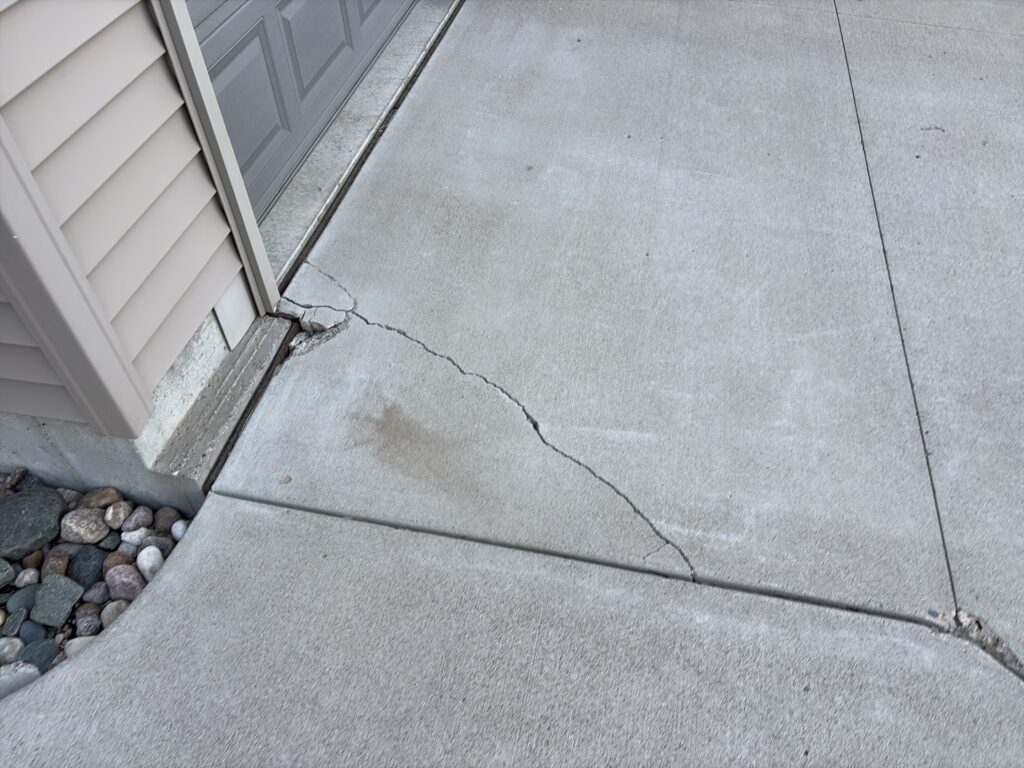
Not every crack is a problem. Thin, tight shrinkage cracks are usually cosmetic. Pay closer attention to:
- Cracks wide enough to let water and soil in
- Cracks where one side sits higher than the other, which can become a trip hazard
- Cracks that get wider from year to year
- Open expansion joints, or joints where the old filler has rotted or fallen out
- A gap where the driveway, walkway or patio meets the foundation, which lets water run straight down along your basement wall
- A slab that sounds hollow when tapped, rocks when you step on it, or has a visible gap underneath at its edge
What it means in your Nordic report
During a Nordic home inspection, we look at driveways, walkways, patios, steps and garage floors. Each finding is color-coded in your report:
| Report finding | Report color | What we recommend |
|---|---|---|
| Minor, moderate or common cracks in a driveway, walkway, patio or steps | Blue | Fill the cracks with an epoxy or acrylic crack filler. |
| Unsealed cracks | Blue | Seal the cracks to keep water out. |
| Unsealed joints, or a gap where the concrete meets the building | Blue | Fill with a polyurethane joint filler or caulk. |
| Void below a driveway, walkway, patio or steps | Blue | Fill the void or stabilize the slab, for example by foam or sand-jacking. |
| Void below a garage or outbuilding floor slab | Orange | Have a qualified concrete contractor evaluate it. |
Blue items are maintenance. They are not urgent, but sealing them now helps prevent bigger and more expensive repairs later. Orange items deserve a closer look by a professional.
How to seal cracks and joints
Sealing cracks and joints is a reasonable do-it-yourself project. Follow the instructions on the product you choose, and keep these basics in mind:
- Clean it out. Remove dirt, weeds, loose concrete and old sealant. The surfaces should be clean and dry.
- Use backer rod in deeper gaps. For joints and the gap at the house, press closed-cell foam backer rod into the opening so the sealant stays shallow. One sealant manufacturer’s data sheet calls for sealant about half as deep as the joint is wide, and at least 1/4 inch deep.
- Use the right product. For horizontal joints and the gap at the house, use a self-leveling polyurethane sealant that stays flexible. For narrow cracks, use a concrete crack filler. Do not pack joints with mortar: joints need room to move.
- Pick the right weather. Seal on a dry day. The same data sheet calls for temperatures above 40°F, so late spring through early fall is the best window here.
- Check every spring. After winter, walk your concrete and reseal anything that opened up. Our Spring Thaw Home Checklist covers this and other after-winter checks.
Voids under concrete and how slabs are lifted
A void is an empty space under the slab. It forms when soil settles or when water washes soil out, often through an open joint, at a downspout, or along the foundation. A slab with nothing under it can crack under the weight of a car, or tip so that water runs toward the house.
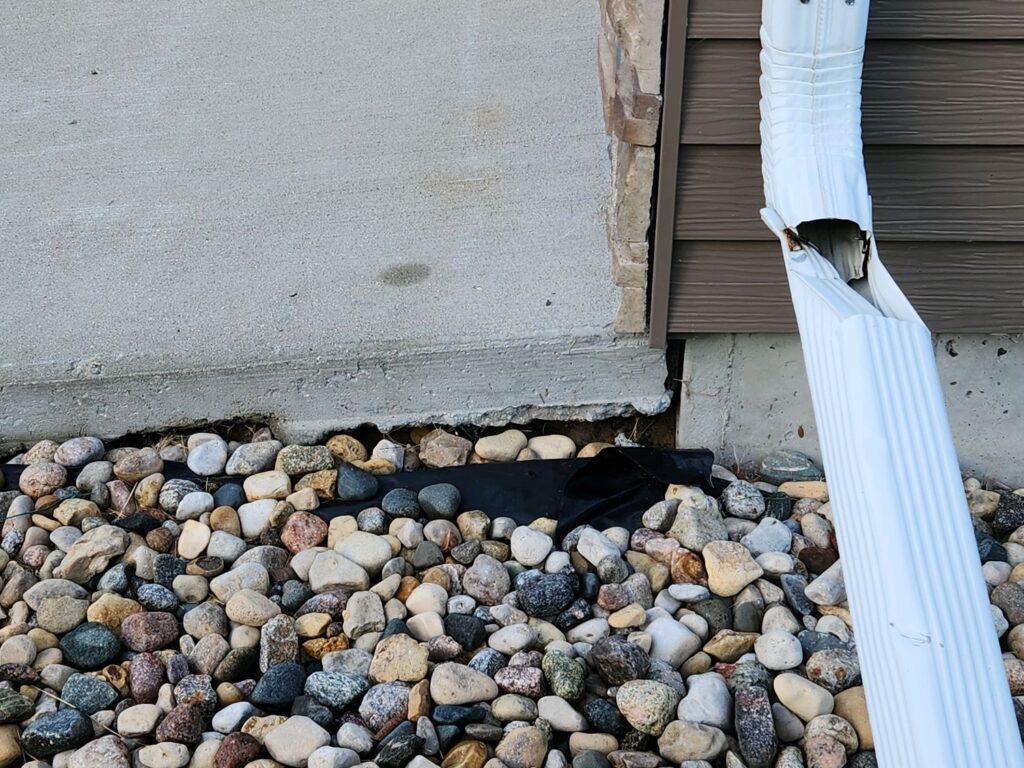
Fix the water problem first, then fill the void. Common methods:
- Mudjacking: a cement-based grout pumped under the slab through holes drilled in it.
- Sand-jacking: sand pumped under the slab to fill the void and raise it.
- Polyurethane foam: an expanding foam injected through small holes. It is much lighter than cement grout. A Tennessee Department of Transportation research project describes the foam at 4 to 6 pounds per cubic foot, compared with 120 to 140 for conventional materials.
Each method can work when done well. Ask the contractor how they will find the full extent of the void, and what warranty they offer. A slab that is badly broken or has dropped several inches may be better replaced. For a void under a garage floor, start with an evaluation by a concrete contractor, as your report recommends.
How to protect your concrete
- Move water away from the house. Extend downspouts and keep the soil sloping away from the foundation. See Lars Knows: Good Grade and Before the Next Heavy Rain.
- Keep cracks and joints sealed, and check them every spring.
- Go easy on deicers. Shovel early and use deicer sparingly. NRMCA considers rock salt (sodium chloride) and calcium chloride acceptable, but never ammonium-based or magnesium-based products.
- Consider a breathable sealer. NRMCA suggests a silane- or siloxane-based sealer, applied to dry concrete according to the maker’s instructions.
- Pouring new concrete? Ask for air-entrained concrete (NRMCA recommends about 6 percent air for typical mixes), a well-compacted base, joints at the right spacing, and at least three days of moist curing.
Concrete driveway cracks: common questions
Is it normal for a new driveway to crack? Some cracking is normal even with good work, which is why joints are cut into the slab. Cracks that run between the joints, keep widening, or leave uneven edges are worth raising with the installer.
Should I seal the gap between my driveway and the house? Yes. Use backer rod and a flexible polyurethane sealant so water cannot run down along the foundation.
Is foam lifting better than mudjacking? Both can work. Foam is lighter and uses smaller holes, while grout and sand methods have a long track record. The contractor’s experience, and fixing the cause of the void, matter more than the method.
Will concrete cracks affect a home sale? Usually not much. In a Nordic report they are typically Blue maintenance items. Voids and slabs that slope toward the house get more attention because they can send water to the foundation.
Sources
- National Ready Mixed Concrete Association. CIP 2: Scaling Concrete Surfaces.
- National Ready Mixed Concrete Association. CIP 4: Cracking Concrete Surfaces.
- National Ready Mixed Concrete Association. CIP 6: Joints in Concrete Slabs on Grade.
- Henkel. Loctite PL Concrete Self-Leveling Polyurethane Sealant, technical data sheet.
- University of Tennessee at Chattanooga for the Tennessee Department of Transportation. Improving Rigid Pavement Smoothness Using PolyLEVEL (RES2016-18).