

An outdoor outlet takes a beating in Fargo-Moorhead. Rain, sprinklers, blowing snow, ice and summer sun all hit it, often for decades. The exterior outlet cover is what keeps that water away from live wiring. When we find a missing, broken or loose cover during a home inspection, it is one of the easiest safety repairs on the list, and one of the most important.
This guide explains what an exterior outlet cover does, the difference between a flip cover and an in-use cover, the signs of a cover that needs attention, what the finding means in an inspection report and how it is fixed.
What an exterior outlet cover does
An outdoor receptacle sits in a box mounted on or in the wall. Without a cover, rain and melting snow can run straight into the slots and the box behind it. Water and electricity together can cause shocks, tripped circuits, corrosion of the receptacle and wiring, and in the worst case, a fire.
A proper cover seals against the wall with a gasket and closes over the receptacle. The Electrical Safety Foundation (ESFi) recommends keeping outdoor outlets covered and dry between uses and installing weatherproof boxes or covers on every outdoor outlet.
Flip covers vs. in-use covers
The National Electrical Code (NEC) separates outdoor locations into two kinds:
- Damp locations are protected from the weather, such as under a roofed porch or canopy. A standard weatherproof flip cover, which seals only when it is closed and nothing is plugged in, is allowed here.
- Wet locations are exposed to rain, snow or sprinklers. This includes most outlets on an open wall, deck or fence. Here the code requires a cover that stays weatherproof even with a cord plugged in.
A flip cover protects the outlet only when it is closed. If a cord for holiday lights, a heated pet bowl or a block heater stays plugged in, the flip lid hangs open and water gets in. That is why in-use covers make sense for any outlet that is used for long periods.
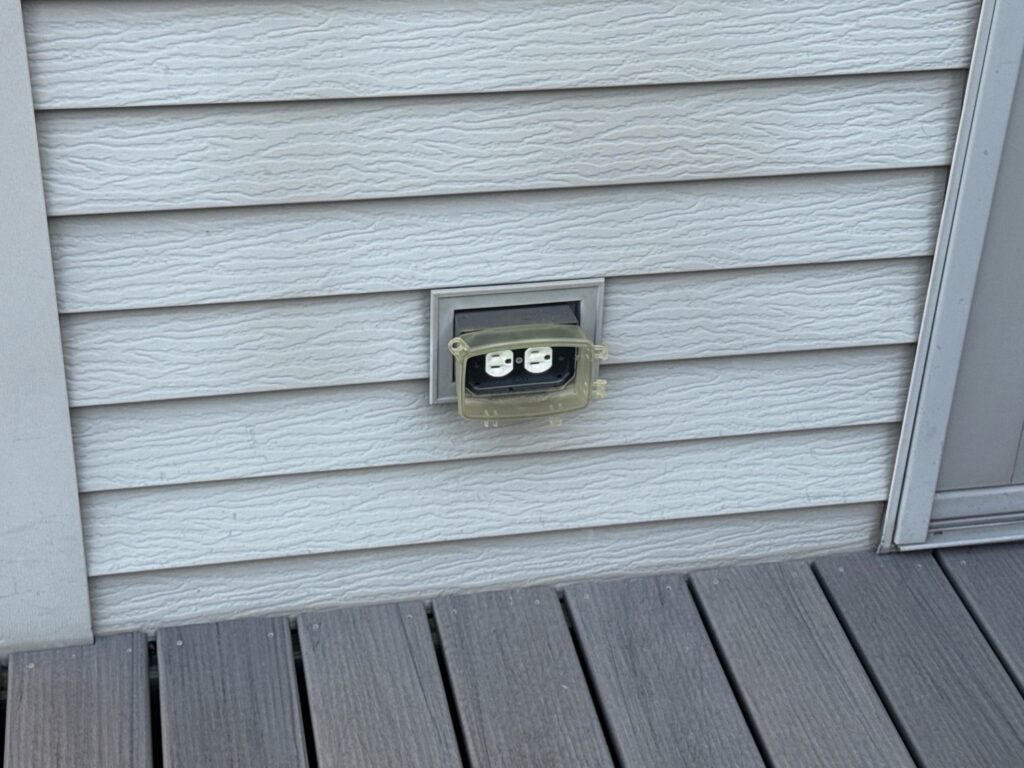
That second type is called an in-use cover, also known as a bubble cover. It has a deep hood with openings at the bottom for cords, so the lid closes over the plug. In wet locations, these hoods must be listed and identified as “extra-duty,” a heavier-duty rating. Look for that marking on the cover.
Other outdoor outlet requirements
Covers are one part of outdoor outlet safety. The NEC also requires:
- GFCI protection. Outdoor receptacles at homes have required ground-fault circuit interrupter (GFCI) protection since 1973. A GFCI quickly cuts power if current leaks to ground, for example through water or a person.
- Weather-resistant receptacles. Receptacles in damp and wet locations must be listed weather-resistant and marked “WR.” They hold up better to moisture and UV light.
- Outlets front and back. Single-family homes need at least one outdoor receptacle accessible from the ground at the front and back of the house.
North Dakota enforces the 2023 NEC. Minnesota moved to the 2026 NEC on August 17, 2026. Older homes were built under earlier codes, so an older outlet may not meet today’s rules even if it was fine when installed.
Signs your outdoor outlet cover needs attention
Walk around your house and check every outdoor outlet, including those on decks, garages and under eaves. Look for:
- No cover at all, or only a flat indoor-style plate
- A lid that is cracked, broken off or won’t stay closed
- A cover pulling away from the wall, or a gap between the cover and the siding
- A missing or hardened gasket
- Plastic that is faded, chalky or brittle from the sun
- A flip cover propped open by a cord that stays plugged in
- Rust, corrosion or dirt inside the box
- A GFCI that won’t reset, or an outlet that trips often in wet weather
What this finding means in an inspection report
When we find a missing, damaged or loose cover, we note it in the inspection report and recommend installing or replacing the cover. Where an outlet is in a wet location and has only a flip cover, we may recommend an in-use cover. We also test outdoor receptacles for GFCI protection and note any that are not protected or don’t trip.
A missing cover is usually a simple fix. But if water has been getting into the box, the receptacle or wiring may be corroded. In that case, we recommend a licensed electrician check the outlet and replace damaged parts.
How a missing or damaged cover is fixed
Replacement covers are sold at hardware stores. Choose one that fits the box and the receptacle type, and pick an in-use, extra-duty cover for any outlet exposed to weather.
- Turn off power to the outlet at the breaker before removing the old cover.
- Check the receptacle. It should be weather-resistant (WR) and GFCI protected. If it is cracked, loose or corroded, have it replaced.
- Mount on a flat surface. On lap siding, a siding mounting block gives the cover a flat surface to seal against.
- Seal it right. Mounting block instructions call for caulk on the top and sides, with the bottom left open so water can drain. Some covers call for a bead of silicone between the gasket and rough surfaces such as brick.
- Install the cover with the hinge at the top and open only the cord ports the instructions call for.
- Restore power and test the GFCI.
If you are not comfortable working with electrical parts, an electrician can replace the cover and receptacle in one visit. Our guide on how to wire an outlet explains the basics.
How to keep outdoor outlets safe
- Test GFCIs every month. The Consumer Product Safety Commission recommends testing at least monthly and after a power outage.
- Close the lid after every use. A flip cover only works when it is shut.
- Use outdoor-rated cords and don’t leave them in snow or very cold weather for long periods, as ESFi advises.
- Check covers each fall and spring. Sun can make plastic brittle over time. A fall home checkup is a good time to catch problems.
Exterior outlet cover: common questions
Do I need an in-use cover on my outdoor outlet?
If the outlet is exposed to rain, snow or sprinklers, current code requires a cover that stays weatherproof with a cord plugged in. Under a covered porch, a flip cover may be acceptable.
Is a missing outdoor outlet cover dangerous?
Yes. Without a cover, water can reach the receptacle and wiring. A working GFCI lowers the shock risk, but the cover is still needed to keep the outlet dry.
What does “extra-duty” mean on an outlet cover?
It is a listing for heavier-duty in-use covers (outlet box hoods). The code requires it for these hoods on 15- and 20-amp receptacles in wet locations.
Can I replace an outdoor outlet cover myself?
Many homeowners do. Turn off the power first and follow the cover’s instructions. Call an electrician if the receptacle or box is damaged or not GFCI protected.
Sources
- EC&M, Code Q&A: Placing receptacles in damp or wet locations
- EC&M, Illustrated Catastrophes: Exposed to the Elements
- Leviton, Understanding while-in-use covers and NEC requirements
- IAEI Magazine, Holiday lighting and outside electrical receptacles
- Minnesota Department of Labor and Industry, residential electrical inspection checklist
- Minnesota Department of Labor and Industry, 2026 NEC adoption
- North Dakota Administrative Code 24.1-06-01-20 (2023 NEC)
- CPSC, GFCI fact sheet
- ESFi, Ground Fault Circuit Interrupters
- ESFi, Outdoor Electrical Safety Check booklet
- Arlington Industries, siding mounting blocks spec sheet
- Intermatic in-use cover installation instructions