

Window condensation mold is one of the most common things we find in Fargo-Moorhead homes in winter: black or gray spots along the bottom of the glass, in the sash track and on the sill, right where water runs down and sits. It is not a window problem so much as a moisture problem. Warm indoor air carries water, the window glass is the coldest surface in the room, and the water condenses there night after night until mold has what it needs. This guide explains why windows sweat here, where the extra moisture comes from, what humidity is right for our winters, how to clean mold off a window and how to stop it from coming back.
Nordic Inspections · Fargo-Moorhead
Worried about mold in your home?
Tell us what you’re seeing, smelling or worried about and we’ll recommend the right next step. A preliminary mold inspection finds the moisture and the growth first, then adds air, surface or mycotoxin sampling only where it answers a real question.
Questions first? Call (701) 566-1446
Start here
Seeing mold on your windows this winter?
- Wipe the water off the glass and sill every morning.
- Clean small spots on hard surfaces with detergent and water, then dry them.
- Turn the humidifier down and run the bathroom and kitchen fans.
- Open the blinds and keep air moving across the glass. Still sweating? Find the source.
The short answer: wet windows in winter mean the indoor air holds more moisture than the cold glass can handle. Mold on windows from condensation grows where that water sits for days. Wipe the water, clean small areas of mold, lower the humidity, run your exhaust fans and keep air moving across the glass. If the windows keep sweating after that, find out where the moisture is coming from.
Why your windows sweat in winter
Air always holds some water vapor. Warm air can hold more than cold air. When indoor air touches a surface that is colder than its dew point, the temperature at which that air can no longer hold all its moisture, some of the water turns back into liquid. That is condensation. The EPA puts it simply: excess moisture condenses on window glass because the glass is cold.
In a Fargo winter the glass is almost always the coldest surface in a room, followed by the metal or vinyl frame and the bottom edge of the glass where the insulating seal is. That is why condensation and frost usually start at the bottom corners and creep up, and why mold shows up first along the lower edge of the glass, in the track and on the sill. For a closer look at the basics, including condensation between the panes, see our post on why windows get condensation in the fall and winter.
The University of Minnesota Extension lists condensation on windows in winter as one of the symptoms of excess moisture in a home, along with mildew, mold and peeling paint. NDSU Extension says the same, and adds that this moisture can promote mold growth on the window’s structure and frame.
Does window condensation cause mold?
Condensation by itself is water, not mold. Mold needs moisture, something to feed on and time. A window that fogs for an hour on a cold morning and dries by noon rarely grows mold. A window that stays wet day after day does.
Window sills, wood frames, the paint and caulk around them, the dust in the sash track and the drywall below all give mold something to eat. When water runs down the glass every night and pools in the track, those surfaces stay damp for weeks. The EPA’s advice is to act quickly: if you see condensation or moisture collecting on windows, walls or pipes, dry the wet surface and reduce the moisture source.
What we see in Fargo-Moorhead homes: mold on windows from condensation turned up in 40% of the 141 preliminary mold inspections we did from April 2025 to November 2026. It is one of our most common findings, and it is usually a sign of how much moisture the whole house is holding, not just that one window.
Where the moisture comes from
Every household adds water to the air. The question is how much, and whether it gets out. The University of Minnesota Extension’s study of moisture sources in cold-climate homes (Angell and Olson, 1988) estimated how much water common sources add to indoor air:
Where the moisture comes from
Pints of water added to indoor air, University of Minnesota estimates
Showers and cooking are real but fairly small one at a time. The largest number on the list is ground moisture: water moving from damp soil through a basement or crawl space into the house.
The ground: usually the biggest contributor here
Lars Knobloch, who leads our mold inspections, says that in Red River Valley homes the biggest contributor to winter window condensation is usually the ground itself. That is his experience from years of inspections, not a measured ranking. Many homes here have footings that sit close to the water table. Concrete is porous, and water wicks up through it the way a paper towel pulls up water. Building scientist Joseph Lstiburek of Building Science Corporation notes that footings typically don’t have a capillary break, so capillary water is drawn up into the footing and then into the foundation wall. From there it evaporates into the basement air and spreads through the house, and it ends up on the coldest surface it can find: the window glass.
That is why two families with the same habits can have very different windows. A home that pulls moisture from the ground all winter can have wet windows even when nobody runs a humidifier.
Humidifiers set too high
A humidifier is the one moisture source people add on purpose. The University of Minnesota study estimated that a humidifier adds about 2 pints an hour on average, and that large models can add 96 to 120 pints a day. A humidifier set for comfort in December can be far too much in a January cold snap. The EPA’s guidance is direct: your humidistat is set too high if excessive moisture collects on windows and other cold surfaces. NDSU Extension’s first step for lowering humidity is to shut off humidifiers.
Showers, cooking and laundry
Daily living adds up, especially in a full house: a family of four breathing and perspiring adds about 0.44 pints an hour, cooking adds about 2 pints a day (closer to 5 with a gas range), and a load of laundry dried indoors or in a dryer that isn’t vented outside adds roughly 4.7 to 6.2 pints. Exhaust fans that are missing, broken, too weak or not used leave that moisture in the house.
What humidity is right in a Fargo winter?
Lower than most people expect. As it gets colder outside, the glass gets colder, and the humidity it can tolerate drops. The EPA publishes these maximum indoor humidity levels, recommended by ASHRAE, for homes with typical windows:
| Outdoor temperature | Recommended maximum indoor relative humidity |
|---|---|
| +20°F | 35% |
| +10°F | 30% |
| 0°F | 25% |
| -10°F | 20% |
| -20°F | 15% |
The University of Minnesota Extension suggests keeping relative humidity around 25% in winter and up to 50% in summer. NDSU Extension recommends keeping it under 40% in winter, and notes that very dry air, below 30%, can lead to dry skin and irritated nasal passages. Our practical advice: buy an inexpensive digital humidity gauge, watch it when the forecast drops below zero, and let your windows be the final judge. If the glass is wet, the humidity is too high for the weather outside.
Not sure whether your windows are a nuisance or a sign of a bigger moisture problem? A preliminary mold inspection measures the temperature, humidity and dew point, finds where the moisture is coming from and checks for hidden mold. Schedule a preliminary mold inspection.
How to stop condensation on windows
Work from the source outward. These steps come from the EPA, the University of Minnesota Extension and NDSU Extension, plus what we see in local homes.
- Lower the humidity. Turn the humidifier down or off when the windows sweat, and use the table above as your guide on cold days.
- Run your exhaust fans. Use the bathroom fan during every shower and for a while afterward, and the range hood when you cook. Make sure both vent outdoors, not into the attic. NDSU Extension recommends running fans during baths and showers and when cooking.
- Vent the dryer outside and avoid drying laundry on racks indoors in winter.
- Keep air moving across the glass. Open blinds and curtains during the day, keep furniture off the windows and the walls below them, and don’t block the heat registers under windows. The EPA recommends using fans and moving furniture away from wall corners to improve air and heat circulation. Heavy curtains and blinds that stay closed keep the room’s warmth off the glass, so the glass gets colder and wetter behind them.
- Keep the glass warmer. Storm windows and caulking around windows keep the inside pane warmer and reduce condensation, according to the EPA. NDSU Extension also suggests window plastic as a winter fix.
- Ventilate the house. In winter, briefly opening a window a little lets warm, moist air out, as the University of Minnesota Extension notes. Homes with a heat recovery ventilator (HRV) or energy recovery ventilator (ERV) should run it and keep it maintained; see our post on HRV and ERV maintenance.
- Deal with ground moisture. If the basement smells damp, the floor or walls show white mineral deposits, or the windows sweat even with the humidifier off, look at drainage, the sump and the foundation. Our post on why mold grows in basements in Fargo homes goes deeper.
One note on older homes: tightening up a house with new windows, insulation and air sealing saves energy, but it also keeps more moisture inside. Our post on why mold and condensation appear in older homes after energy upgrades explains how to balance the two.
How to clean mold on window sills and frames
Small areas of mold on hard window surfaces are usually a homeowner job. The EPA says an area smaller than about 10 square feet can generally be handled yourself, and recommends scrubbing mold off hard surfaces with detergent and water and drying them completely.
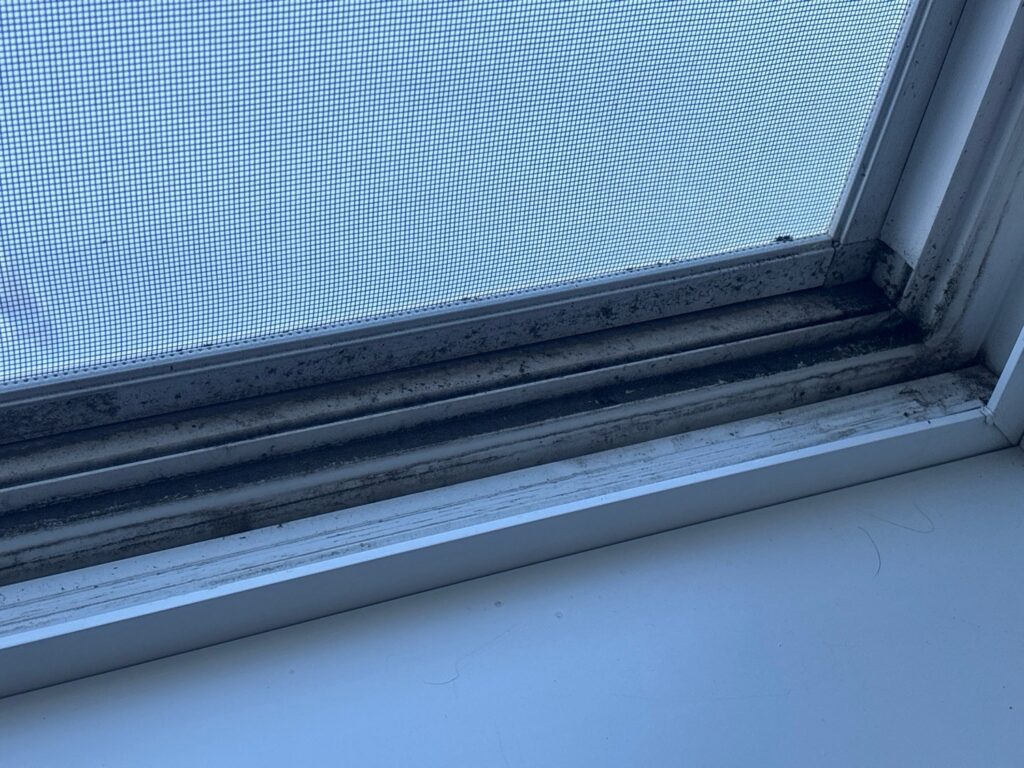
- Dry the window first and open the sash if it opens, so you can reach the track.
- Vacuum loose debris from the track, ideally with a HEPA vacuum.
- Scrub the glass, frame, track and sill with detergent and water, then wipe them dry.
- Replace what can’t be cleaned. Soft, rotted wood, crumbling caulk and moldy drywall below the window may need to be replaced.
- Fix the moisture. If you only clean, the mold will be back next month.
We don’t recommend bleach for this. Our post on using bleach and vinegar on mold explains why. If you have asthma, allergies or a weakened immune system, ask someone else to do the cleaning.
When window condensation mold is a sign of something bigger
Window mold by itself is common and usually manageable. Call for a closer look when:
- Every window in the house sweats, not just the bathroom or a bedroom with the door closed. That points to a whole-house moisture source.
- The windows stay wet with the humidifier off. Ground moisture or another hidden source is likely.
- The drywall below the window is stained, soft or bubbling, or the wood frame is soft. Water may be getting into the wall.
- There is a musty odor, which the EPA lists as a sign of hidden mold.
- Someone in the home has asthma, allergies or another health concern. The CDC notes that people with asthma or mold allergies may react more strongly to mold. Talk with your physician about symptoms, and see our post on mold exposure symptoms and your health.
How we check window condensation in an inspection
When we look at sweating windows, we measure instead of guessing. We record the indoor temperature, relative humidity and dew point, and we use thermal imaging to read the surface temperature of the glass, frames and the walls around them. When a surface is at or below the dew point of the room air, it will collect water, and the thermal camera shows exactly where. We use moisture meters to check whether the sill, the drywall below and the framing are actually wet, then follow the moisture back to its source, whether that is the basement, a humidifier, a bathroom or the ground.
Testing is not the first step. Visible mold on a window doesn’t need a lab to identify it; it needs cleaning and a moisture fix. We add air or surface samples only when they answer a real question, such as whether mold is hidden in a wall. Our guide to mold testing options explains when testing helps.
Experience you can check
Nordic Inspections has inspected homes in Fargo-Moorhead, North Dakota and Minnesota since 2010. Our mold work is led by Lars Knobloch, a Council-certified Indoor Environmentalist (ACAC CIE) and ASHI Certified Inspector who is also a certified radon measurement professional and radon mitigation specialist. Lars has provided litigation support on building defects and environmental problems, and our mold samples are analyzed by EMSL Analytical.
Nordic doesn’t remove mold, so our findings have no cleanup to sell. Our mold inspection and testing page explains how an inspection works, and the Mold Resource Center brings all of our mold articles together.
Frequently asked questions
Does window condensation cause mold?
It can. Condensation that dries quickly rarely causes mold, but water that sits on the glass, track and sill day after day lets mold grow on dust, paint, caulk and wood. Dry the window, lower the humidity and fix the source.
Is mold on windows harmful?
It can be for some people. The CDC says mold can cause a stuffy nose, coughing or wheezing, burning eyes or a skin rash in sensitive people, and stronger reactions in people with asthma or mold allergies. Many people have no symptoms. Clean small areas promptly and talk with your physician if you have symptoms.
Why is there mold on my window sill?
Water from condensation runs down the glass and collects on the sill and in the track, where dust and the finish give mold something to feed on. A sill that stays damp for days in winter is enough.
What humidity should my house be in winter to avoid condensation?
It depends on the outdoor temperature. The EPA’s ASHRAE-based table recommends no more than 25% indoor humidity at 0°F and 20% at -10°F. If your windows are wet, the humidity is too high for that day’s weather.
Should I test the mold on my windows?
Usually not. Visible mold on a window should be cleaned and its moisture source fixed, which is also the CDC’s and EPA’s general advice. Testing makes sense when you suspect hidden mold, for example a musty odor or stained drywall below the window.
Sources
- U.S. EPA, What are the main ways to control moisture in your home?
- U.S. EPA, A Brief Guide to Mold, Moisture and Your Home
- U.S. EPA, Mold Cleanup in Your Home
- University of Minnesota Extension, Controlling moisture problems in your home
- W. J. Angell and W. W. Olson, University of Minnesota Extension Service, Moisture Sources Associated with Potential Damage in Cold Climate Housing (1988)
- NDSU Extension, Eliminate Condensation on Windows
- Joseph Lstiburek, Building Science Corporation, BSI-123: Capillarity Sucks
- Joseph Lstiburek, Building Science Corporation, BSD-103: Understanding Basements
- CDC, Mold