
Mold in college apartments and dorms is one of the most common indoor problems students run into, and one of the most stressful, because the person who has to fix it is usually a landlord or a residence life office, not you. This guide is for students and for the parents helping them from a distance. It covers why student housing is prone to mold, how to spot it, what to do and who to call in Fargo-Moorhead, what North Dakota and Minnesota law says about repairs, and when an independent inspection makes sense.
Nordic Inspections · Fargo-Moorhead
Worried about mold in your home?
Tell us what you’re seeing, smelling or worried about and we’ll recommend the right next step. A preliminary mold inspection finds the moisture and the growth first, then adds air, surface or mycotoxin sampling only where it answers a real question.
Questions first? Call (701) 566-1446
Start here
Found mold in your apartment or dorm room?
- Photograph it, with the date, and note any water you can see.
- Report it in writing to your landlord or residence life office, and keep a copy.
- Don’t scrub large patches yourself, and in campus housing don’t clean it at all.
- Keep moisture down (fans on, laundry in a vented dryer) and follow up if nothing happens.
The short answer: mold needs moisture, so every mold problem has a water problem behind it. Take photos, report it in writing to your landlord or residence life office, and keep the moisture down while you wait for the repair. If the landlord won’t act, North Dakota and Minnesota both give tenants options, and cities like Fargo and Moorhead inspect rental housing.
Why mold in college apartments and dorms is so common
Mold is everywhere outdoors and indoors. It only becomes a problem when it has moisture, something to grow on and time. NDSU’s Safety Office puts it simply: mold needs moisture to grow, and fixing the moisture solves the mold problem. Student housing tends to stack up the conditions that keep things damp:
- Older rentals. Many off-campus rentals are older houses and apartment buildings with aging windows, roofs and plumbing.
- Basement bedrooms. Below-grade rooms are cooler and closer to ground moisture, so condensation and musty odors are common. Our post on why mold grows in basements in Fargo homes explains why.
- Bathrooms without a working fan. Fargo’s rental code requires every bathroom to have mechanical ventilation that exhausts outdoors unless there is a window. A fan that is missing, broken or never switched on leaves shower steam on the ceiling and walls.
- More people, more moisture. Several roommates showering, cooking and breathing in a small unit add a lot of water to the air.
- Laundry drying indoors. Racks of wet clothes in a bedroom release that water into the room.
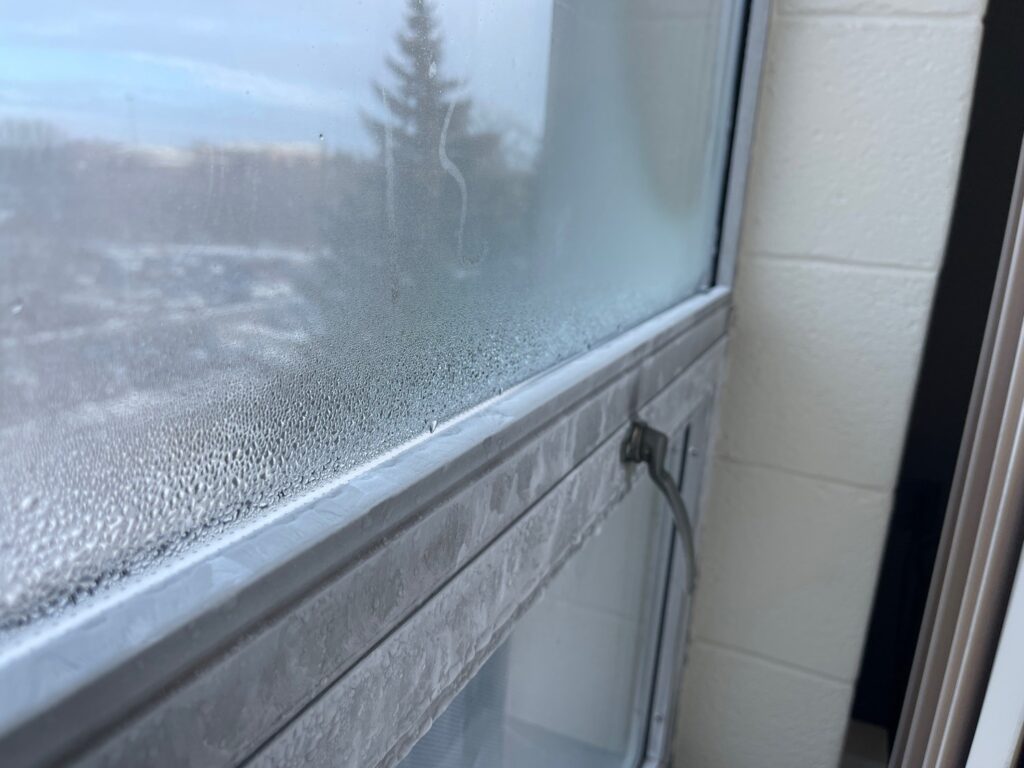
- Winter condensation. In a long heating season, warm, moist indoor air meets cold window glass and exterior walls. Water collects on sills and in corners, and mold follows; our post on window condensation mold explains how to stop it.
- Blocked airflow. Furniture, boxes and beds pushed tight against exterior walls, or vents covered up, create cold, still pockets where moisture lingers.
How to spot mold in a dorm room or apartment
Mold usually shows itself before it becomes a big problem. Common signs, from NDSU’s mold guidance:
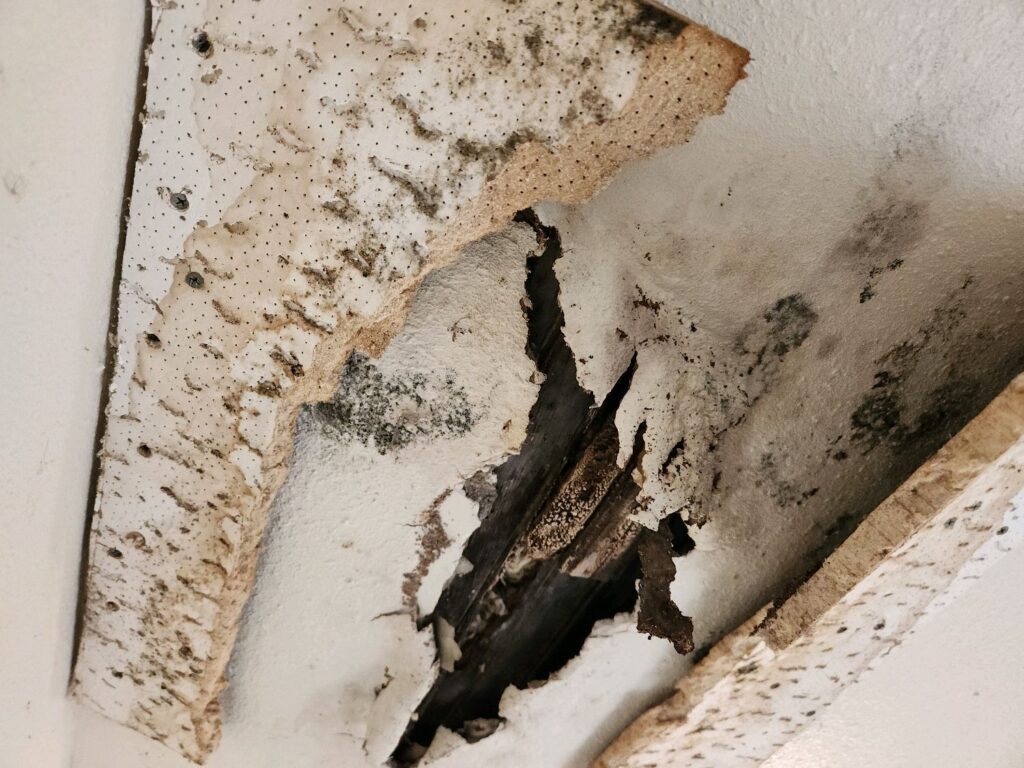
- Spots, patches or streaks on walls, ceilings, floors, window sills or furniture
- A musty, earthy or “old basement” odor
- Water stains, bubbling paint or peeling drywall
- Heavy condensation on windows or cold surfaces
- Dampness that doesn’t go away, or signs of an active or past leak
Mold can be black, green, white, brown or gray, and color alone doesn’t tell you how harmful it is. The CDC says you don’t need to know the type of mold: if it’s growing indoors, it should be cleaned up and the moisture problem fixed. Some stains and dust look like mold and aren’t, which is one reason a careful look matters more than a guess.
Can mold in an apartment make you sick?
It can, and it affects people differently. The CDC says damp and moldy places may cause a variety of health effects, or none at all. For some people, mold can cause a stuffy nose, sore throat, coughing or wheezing, burning eyes or a skin rash. People with asthma or mold allergies may have severe reactions, and people with weakened immune systems or chronic lung disease can get lung infections from mold.
That’s why “mold in dorm symptoms” is such a common search. Symptoms from mold often look like a cold or seasonal allergies, which makes them hard to sort out on your own. If you have asthma, allergies or another health condition, tell your doctor or campus health service about the mold, and say so in your written report to the landlord or residence life too. It is reasonable to ask whether you can move to a different room while repairs are made. This is educational information, not medical advice. Our posts on mold exposure symptoms and who is most at risk from mold go deeper.
Mold in your apartment: what to do
These steps work whether you rent an apartment, a room in a house or a dorm room.
- Take photos and notes. Photograph the growth, any stains and any water source, with the date. Note when you first noticed it and any symptoms.
- Look for the water. Is there a leak, a drip under the sink, a wet window sill, a bathroom without a working fan? Report active leaks right away; water that sits is what feeds mold.
- Report it in writing. Email or a written maintenance request creates a record. Describe what you see, where, and since when. Keep a copy.
- Be careful about cleaning it yourself. In campus housing, don’t. NDSU, for example, asks students not to clean or disturb suspected mold and to report it instead. In an apartment, the EPA says a moldy area smaller than about 10 square feet (roughly a 3 by 3 foot patch) can usually be handled with detergent and water on hard surfaces. Larger areas and mold that keeps coming back are the landlord’s job, and the EPA notes that absorbent materials like ceiling tiles and carpet may have to be thrown away once moldy. Painting over mold doesn’t fix it. If you have asthma or allergies, let someone else do even small cleanups.
- Keep the moisture down while you wait. Run the bathroom fan during and after showers, use the kitchen fan when cooking, dry laundry in a vented dryer, keep furniture a few inches off exterior walls and don’t block vents. The EPA recommends keeping indoor humidity below 60 percent, ideally between 30 and 50 percent; an inexpensive humidity gauge will tell you where you stand.
- Follow up. If nothing happens within a reasonable time, follow up in writing, then move to the next step in “Who do I call” below.
Landlord says it’s “just mildew,” or the same spot keeps coming back? A preliminary mold inspection finds the moisture source, documents the growth and gives you an independent written report to share with your landlord or your parents. Schedule a preliminary mold inspection.
Mold in college dorms: how residence life handles it
In a residence hall, the school is the landlord, and most schools have a set process. NDSU is a good example. Its Residence Life office takes maintenance requests online, and its Safety Office has a Mold Concern Form and an indoor air quality contact (ndsu.iaq@ndsu.edu, 701-231-7759). When the Safety Office investigates, it checks for visible mold, stains, leaks, humidity, odors and ventilation, takes moisture and humidity readings, finds and fixes the moisture source, and tells the resident what it found. Urgent problems like active leaks, flooding or strong odors should also go straight to Residence Life or the Safety Office.
NDSU also says air testing is rarely recommended, because there are no federal “safe mold levels” and the focus belongs on moisture and visible growth. That matches what the CDC and EPA say about mold testing in homes.
Students at Minnesota State University Moorhead, Concordia College or any other school should contact their own residence life or housing office the same way: in writing, with photos, and with a request to be told what was found.
Who do I call to report mold in my apartment?
Start with the landlord or property manager, in writing. If that doesn’t work, local and state resources can help.
- Fargo. The City of Fargo Inspections Department inspects rental housing and enforces the International Property Maintenance Code. It asks tenants to contact the owner or property manager in writing first and give them a reasonable time to respond. If the issue isn’t resolved, call a rental housing inspector at 701-476-6708, email the department or report it through Fargo One. The city can help with health and safety conditions but not with lease, deposit or eviction disputes.
- Moorhead. The City of Moorhead requires rental properties to be registered and inspects them annually. Its Neighborhood Services office (218-299-5434) lists tenant resources, including a tenant request-for-repairs form.
- North Dakota. The Attorney General’s Tenant Rights page explains tenant rights and responsibilities, but its office can’t take or mediate landlord-tenant complaints. It points tenants to Legal Services of North Dakota or a private attorney.
- Minnesota. HOME Line runs a free tenant hotline for all of Minnesota (1-866-866-3546 outside the Twin Cities). Legal Services of Northwest Minnesota has an office in Moorhead.
Mold in an apartment: tenant rights in North Dakota and Minnesota
Here is what the state laws say in plain words. This is general information, not legal advice. Laws change, so check the current text at the links in Sources and talk with a legal aid office or attorney about your own situation.
North Dakota. Under North Dakota Century Code section 47-16-13.1, a residential landlord must follow the building and housing codes that materially affect health and safety, make the repairs needed to keep the unit fit and habitable, and keep the plumbing, heating, ventilating and other facilities they supply in good and safe working order. Section 47-16-13.2 gives tenants their own duties, such as keeping their part of the unit clean and safe and using the facilities reasonably. Under section 47-16-13, if the landlord neglects to make repairs within a reasonable time after the tenant’s notice, the tenant may repair and deduct the cost from rent, recover it another lawful way, or move out and be released from further rent. Those are serious steps; get advice before using them. North Dakota landlords must also give tenants a written statement of the unit’s condition at move-in.
Minnesota. Under Minnesota Statutes section 504B.161, every residential lease includes the landlord’s promise that the unit is fit for its intended use, kept in reasonable repair and kept in compliance with state and local health and safety laws, except where the tenant caused the damage through willful, malicious or irresponsible conduct. These promises can’t be waived in the lease. For many repair problems, if a violation isn’t fixed within 14 days after the tenant’s written notice, section 504B.385 lets the tenant deposit the rent with the court administrator in a rent escrow action instead of paying the landlord. Section 504B.285 protects tenants against an eviction meant as a penalty for a good-faith repair request or a report to a code inspector. And under section 504B.182, landlords must tell new tenants they can ask for a move-in inspection.
Either way, the tenant’s best tool is a clear written record: photos, dates, copies of every request and the landlord’s replies.
How parents can help from a distance
Parents can’t see the apartment, but they can make a big difference:
- Before the lease. Ask the landlord about past leaks or mold. Ask for a video walkthrough of the bathroom fan running, the windows and any basement bedroom. A musty smell on a tour is worth asking about.
- At move-in. Help your student photograph every room and fill out the condition statement or request the move-in inspection.
- During the winter. Send a small humidity gauge and a reminder: fans on, windows wiped, furniture off the exterior walls.
- When something goes wrong. Help write the first notice to the landlord, keep copies, and set a date to follow up. If your student has asthma or allergies, make sure that’s in the notice.
- When to step in. If the landlord stalls, the mold keeps coming back or your student is getting sick, call in outside help: the city inspector, a tenant hotline, legal aid or an independent inspection.
When an independent mold inspection makes sense
Most mold in student housing is handled with a report and a repair. An independent inspection helps when:
- The landlord disputes the problem or says it’s the tenant’s fault
- The same spot keeps coming back after cleaning
- There’s a musty odor but no visible mold, which the EPA lists as a sign of hidden mold behind walls or under carpet
- A student with asthma, allergies or another health condition lives there
- A leak or flood was cleaned up quickly and you want to know it’s really dry
- A parent wants a professional look before signing a lease
Testing isn’t the first step. The CDC doesn’t recommend routine mold testing, and NDSU’s Safety Office rarely recommends air testing for the same reason: there are no federal limits for mold, and moisture and visible growth tell you more. Our guide to mold testing options explains when a test helps and when it doesn’t, and how to read mold test results explains what the numbers mean.
Experience you can check
Nordic Inspections has inspected homes in Fargo-Moorhead, North Dakota and Minnesota since 2010. Our mold work is led by Lars Knobloch, a Council-certified Indoor Environmentalist (ACAC CIE) and ASHI Certified Inspector who is also a certified radon measurement professional and radon mitigation specialist. Lars has provided litigation support on building defects and environmental problems, and our mold samples are analyzed by EMSL Analytical.
Nordic doesn’t remove mold, so our findings have no cleanup to sell. A preliminary mold inspection looks for visible growth and traces its moisture source with moisture meters and thermal imaging, samples only where it answers a real question, and explains lab results in a written report with clear next steps. Our mold inspection and testing page explains how it works, and the Mold Resource Center brings all of our mold articles together.
Frequently asked questions
Is mold in college dorms common?
Mold can show up in any building with a moisture problem, and dorms and student rentals often have the conditions that cause it: crowded rooms, steamy bathrooms, laundry drying indoors and cold winter windows. Report it early; small problems are easier to fix.
What are the symptoms of mold in a dorm room?
The CDC lists a stuffy nose, sore throat, coughing or wheezing, burning eyes and skin rash for people who are sensitive, and more severe reactions for people with asthma or mold allergies. Many people have no symptoms. Talk with your doctor or campus health service about your own symptoms.
Who do I call to report mold in my apartment?
Your landlord or property manager first, in writing. In Fargo, if the landlord doesn’t respond, the City of Fargo Inspections Department (701-476-6708) handles rental housing complaints. In Moorhead, contact Neighborhood Services (218-299-5434). In a dorm, contact residence life.
How do you test for mold in an apartment?
Usually you start with a look, not a test. The CDC doesn’t recommend routine mold testing, and visible mold should simply be cleaned up and its moisture source fixed. When mold is suspected but hidden, a professional inspection with moisture meters, thermal imaging and targeted air or surface samples can answer the question. Do-it-yourself kits can’t answer it reliably.
Can I break my lease because of mold?
Sometimes. In North Dakota, section 47-16-13 lets a tenant move out and stop paying rent if the landlord neglects needed repairs within a reasonable time after notice. In Minnesota, the usual route is rent escrow: you deposit the rent with the court instead of simply not paying. These steps carry risk, so talk with legal aid, HOME Line (Minnesota) or an attorney before moving out or holding back rent.
Who pays for mold removal in a rental?
Usually the landlord, because both states require landlords to keep units in repair and meet health and safety codes. The exception is damage the tenant caused, which is why keeping the unit ventilated and reporting leaks quickly matters.
Sources
- CDC, Mold
- U.S. EPA, Mold Cleanup in Your Home
- U.S. EPA, A Brief Guide to Mold, Moisture and Your Home
- NDSU University Police and Safety Office, Mold
- NDSU Residence Life, Maintenance Requests
- City of Fargo Inspections Department, Rental Housing Inspections
- City of Moorhead, Rental Housing
- North Dakota Attorney General, Tenant Rights
- North Dakota Century Code, chapter 47-16, Leasing of Real Property (sections 47-16-13, 47-16-13.1 and 47-16-13.2; section text also at FindLaw)
- Minnesota Statutes, chapter 504B, Landlord and Tenant (sections 504B.161, 504B.182, 504B.285 and 504B.385)
- Minnesota Attorney General, Landlords and Tenants: Rights and Responsibilities, resource directory