
On a frosty morning, you may notice something odd about a twin home roof: a strip of bare shingles running straight up the roof, right above the wall the two homes share, while the rest of the roof stays white. That melted line is a clue that warm air is escaping up through the party wall. In some twin homes, the same air carries moisture into the attic and leaves stains or party wall mold on the attic side of the wall. Here is how that happens, what you can safely check, and the fix.
Nordic Inspections · Fargo-Moorhead
Worried about mold in your home?
Tell us what you’re seeing, smelling or worried about and we’ll recommend the right next step. A preliminary mold inspection finds the moisture and the growth first, then adds air, surface or mycotoxin sampling only where it answers a real question.
Questions first? Call (701) 566-1446
Noticed a melted line above the party wall? Start here.
- Don’t assume the worst. The line shows warm air reaching the roof deck; on its own, it does not mean a moisture or mold problem.
- On a cold day, look into the attic from the hatch with a flashlight and aim it at the party wall where it meets the top of the insulation.
- Look for frost, water stains or dark spots, notice any musty smell, and take photos. Don’t touch or spray anything.
- If you find stains or growth, have the moisture source and the extent checked before anyone cleans or covers it.
A melted frost line doesn’t mean the attic has mold
Lars Knobloch, who leads Nordic’s mold work, wants this said first: a melted line on a frosty morning does not mean a twin home has a moisture or mold problem. It tells you warm air is reaching the underside of the roof above the party wall.
In the twin home attics we look at, the range is wide. Some have no stains on the party wall at all. Some have only light stains. Others have a lot of moisture and mold along the wall and the roof framing above it. The roof can’t tell you which one you have. A look inside the attic can.
Energy advisors read frost the same way. Advanced Energy, writing about roofs without frost, says missing frost could mean heat is leaking out of the house, which “isn’t a major concern, but it can be associated with some negative outcomes.” The line above a party wall deserves the same attitude: worth a look, not a reason to panic.
What a twin home party wall is
Twin homes are common in Fargo-Moorhead: two homes side by side, sharing one wall down the middle. That shared wall is the party wall. Many people call it the firewall, because its job is to slow a fire from spreading from one home to the other.
In code terms, Minnesota’s Department of Labor and Industry treats a twin home as a two-unit townhouse, “typically located on two separate individual lots,” and says the units “must be separated from the foundation to the roof by a double wall” of two one-hour fire-rated walls (certain sprinklered buildings may use one common wall). The International Residential Code, which North Dakota’s State Building Code adopts, has the same double-wall option (Section R302.2.1 in the 2021 edition) and requires the separation to run “from the foundation to the underside of the roof sheathing” (R302.2.3). A duplex on a single lot follows a separate one-hour rule for two-family dwellings (R302.3).
Here is what we see in the field. Many twin homes are built as two stud walls with an air gap between them, starting on the concrete footing in the basement and running all the way up to the roof deck. In those homes, the party wall keeps going above the ceiling, covered in drywall, right up to the underside of the roof. The code rules are about fire; how the bottom of the wall handles ground moisture is a separate question.
Why the roof melts in a line above the party wall
Frost settles on cold shingles. As building science writer Allison Bailes of Energy Vanguard puts it, “Warm shingles don’t allow frost to form as readily as cold shingles.” Heat that gets into the attic warms the air there, that air warms the roof deck, and the deck warms the shingles above it.
NDSU Extension uses the same logic for snow. The snow on a house “should look like it does on an unheated, detached garage,” with only a little melt around the edges. Bare spots mean “warm air leaking from the living area that warms the roof.” The melted line above a party wall is the frost version of that bare spot, drawn in one narrow strip.
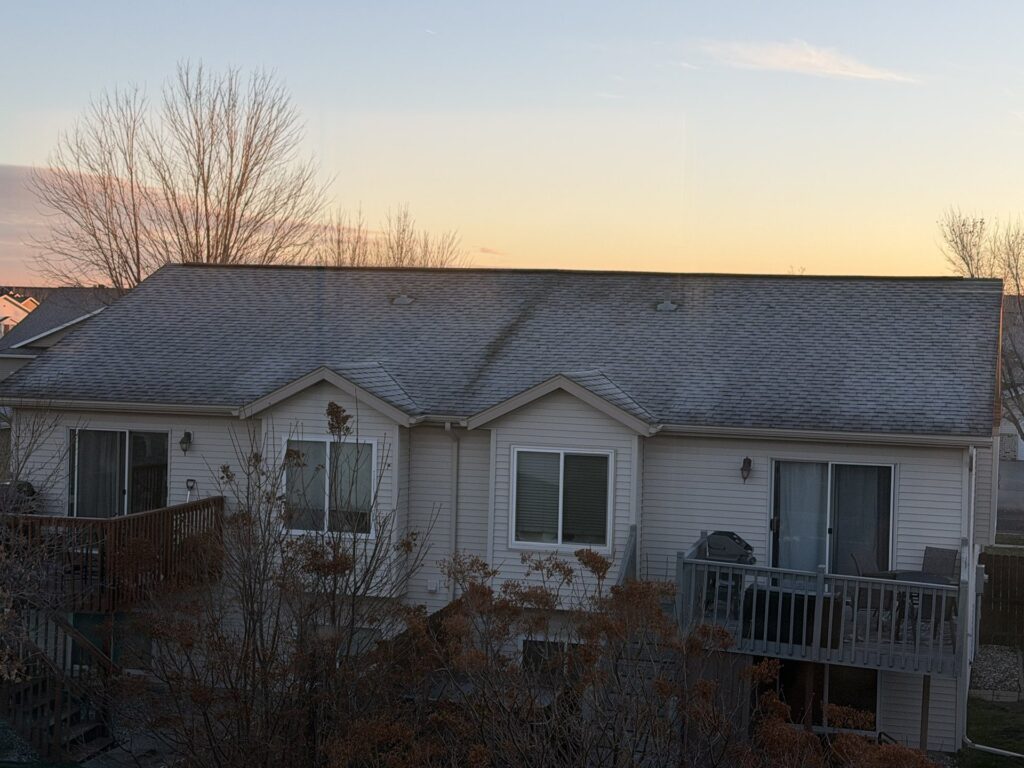
The force behind it is the stack effect. Natural Resources Canada explains that in a heated home, “less dense warm air rises and expands, creating a higher-pressure area near the top of the house,” while lower pressure near the bottom draws outside air in. A U.S. Department of Energy resource adds that “warm air typically leaks out of homes through attics via the stack effect.” A party wall with an open gap from the footing to the roof deck gives that rising air a straight path up, a bit like a chimney, which is why the melted strip follows the party wall.
How moisture gets into the party wall
Stains and mold need moisture. In the twin homes we inspect, it comes from two places.
From the ground. At the bottom, the party wall sits on the concrete footing. Building scientist Joseph Lstiburek of Building Science Corporation writes that “Concrete is porous and susceptible to capillarity,” that “Capillary water is drawn up into the footing,” and that footings typically do not have capillary breaks, the layer that stops water from wicking upward. He notes this is also called rising damp. When there is no capillary breaker or moisture barrier between the footing and the bottom of the party wall, moisture from the ground wicks up through the concrete and into the wall.
From the house. Air from the basement and the living space also leaks into the gap between the two stud walls. Natural Resources Canada calls airflow “the main means by which moisture is carried into the envelope,” the shell of the house.
Inside the wall, all of that air stays at about house temperature, so nothing cools it on the way up. The warm, moist air rises through the gap and into the attic.
Why party wall mold shows up at the insulation line
Below the attic insulation, the party wall is surrounded by the heated house. Above it, the wall stands in the attic, which in a well-insulated home is cold in winter. Natural Resources Canada notes that more insulation makes the attic colder, so “any vapour escaping into the attic can condense before it can be vented.”
That cold surface is where the moisture lands. The U.S. EPA states the rule simply: “When warm, humid air contacts a cold surface, condensation may form.” The National Weather Service defines the dew point as “the temperature to which the air must be cooled in order for that air to be saturated.” When the warm, moist air from the wall gap meets drywall or wood colder than its dew point, water comes out of the air onto that surface. It is the same physics that fogs a window, and our post on window condensation and mold walks through it step by step.
In deep cold, that moisture often shows up as frost. The Building America Solution Center, a U.S. Department of Energy resource, notes that in cold conditions “condensation often occurs as frost,” and that frost itself generally isn’t the problem: the moisture returns to liquid when warmer weather arrives.
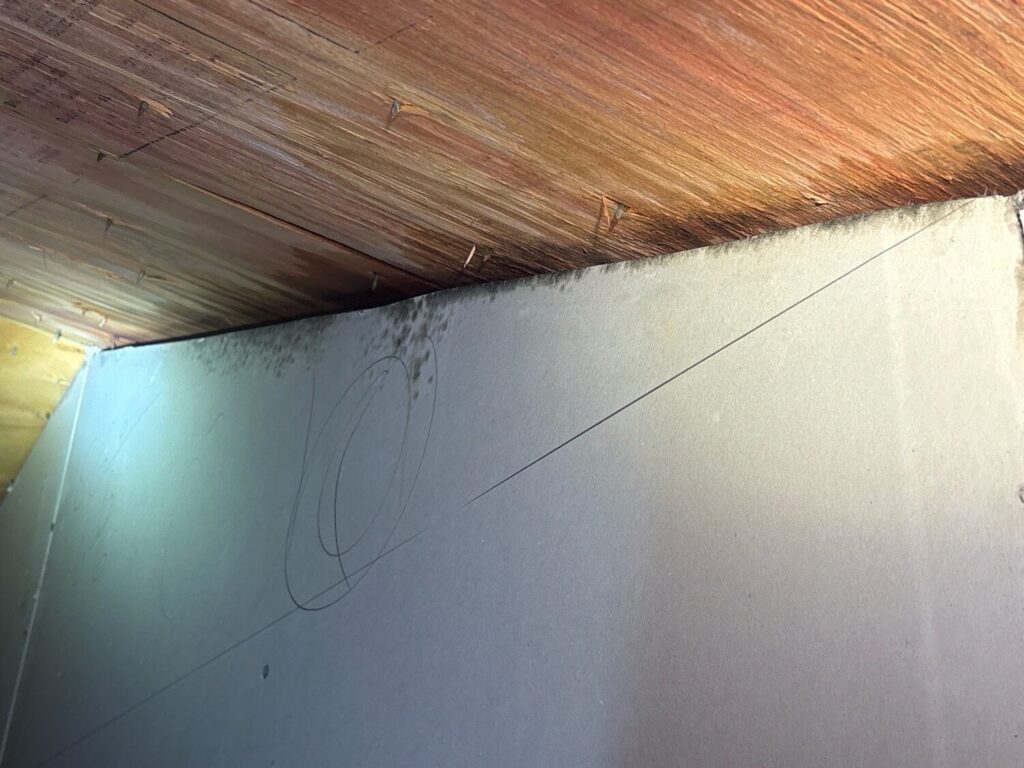
That is why stains or mold can show up on the party wall drywall right at the insulation line, where the wall first turns cold, and sometimes all the way up along the roof structure above the wall. As the EPA puts it, “The key to mold control is moisture control.”
When we find this, our inspection reports call it out with a recommended fix. The comment reads:
“Moisture stains observed on party wall. This is likely caused by missing vapor barrier at the very bottom of the party wall. When no vapor barrier is present, air and moisture will rise into the attic through the wall cavity and condense when reaching colder surfaces in the attic.”
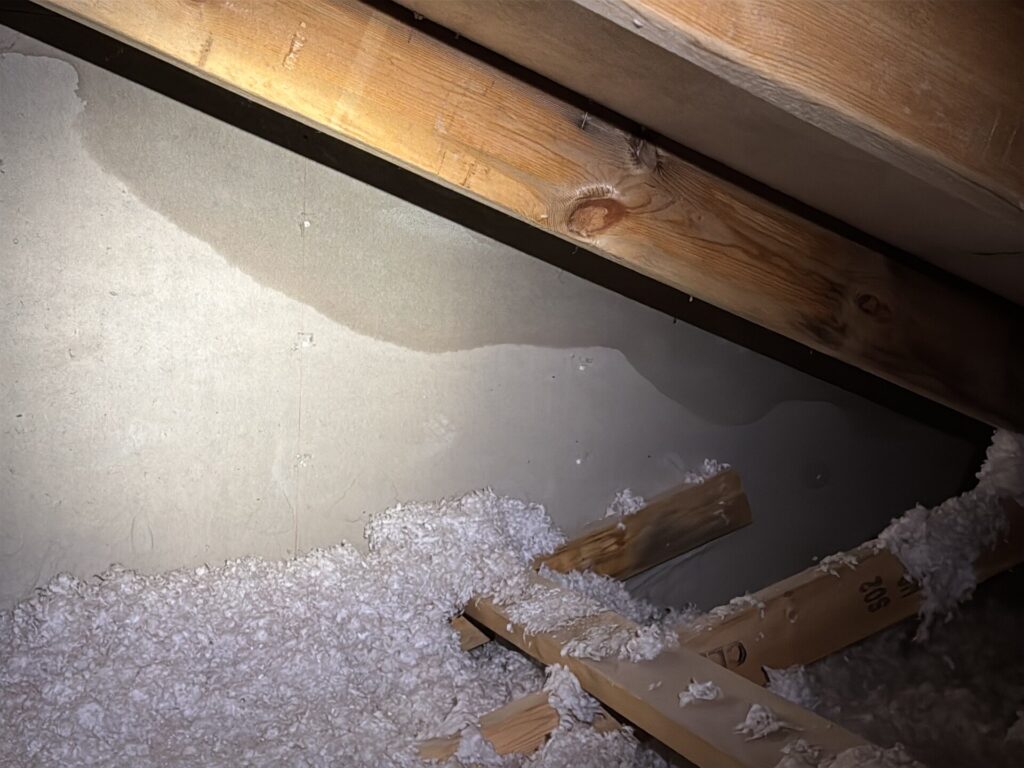
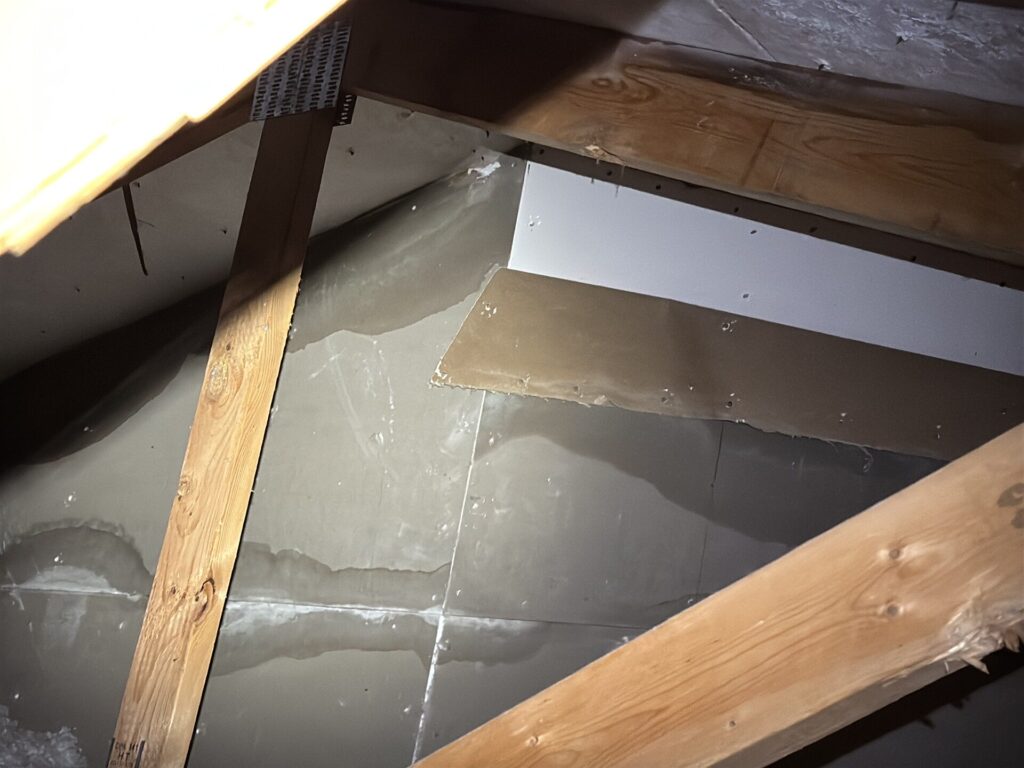
Found stains on the attic side of a party wall and not sure how far they go? A preliminary mold inspection looks for the moisture source and the extent of any mold first, so the plan fits the house. Schedule a preliminary mold inspection.
What you can safely check from the attic hatch
You don’t need to crawl across the attic to learn a lot. Most of what matters is visible from the hatch.
- Pick a cold day. Natural Resources Canada suggests checking the attic “during or just after a cold snap,” when condensation shows up as frost.
- Stay on the ladder. Open the hatch and look from there with a good flashlight. Don’t walk out onto the insulation; the framing underneath is hard to see.
- Find the party wall. Look at its drywall right where it meets the top of the insulation, then follow it up toward the roof.
- Look for moisture signs. Frost on the wall, water stains, dark spots or fuzzy growth. Natural Resources Canada also points to “water marks on the underside of the sheathing or along rafters,” and calls discolored insulation “a tell-tale sign of air leakage.”
- Notice the smell. The EPA says you may suspect hidden mold “if a building smells moldy, but you cannot see the source.”
- Take photos and leave it alone. Don’t scrape, spray or wipe anything. The EPA’s advice is simple: “Avoid touching mold or moldy items with your bare hands.”
What you might find, and when to call someone
- A clean, dry party wall. No stains, no frost, no musty smell. Even with a melted line on the roof, that is a good result. Take another look during the next cold snap.
- Light stains. Worth a closer look, so you know whether moisture is still coming up and how far it reaches.
- Heavy frost, wet wood, dark growth or a musty smell. Time to call a qualified professional to find the source and the extent before anyone cleans, covers or replaces anything.
Call, too, if you can’t tell what you are looking at. From a hatch, a water stain and mold can look alike, and a roof leak can stain wood too.
The fix: stop the moisture at the footing
Because the moisture starts at the bottom of the wall, the fix Nordic recommends starts there too. The goal is to stop moisture from coming up out of the footing, not to chase it in the attic. In general terms, the repair goes like this:
- The bottom of the party wall is opened up in the basement, where the wall sits on the concrete footing.
- The wall is sealed from the concrete with a capillary breaker or moisture barrier and closed-cell spray foam.
- The wall is insulated and closed up again.
With no moisture rising from the footing, the attic side of the party wall stays dry. Once the moisture and warm air stop rising through the wall, the melted line on the roof usually goes away too.
The building science behind it is well known. Lstiburek notes that “Capillary breaks can also be located over the top of concrete footings.” A U.S. Department of Energy Building America guide describes closed-cell spray foam at typical thickness as “essentially moisture-vapor impermeable” and credits it with “excellent air-sealing characteristics.” Together, the barrier and the foam keep ground moisture out of the wall and help keep basement air out of the gap.
Because the party wall is shared, the repair needs both sides: the bottom of the wall is opened and sealed from both homes, so plan on working it out with your neighbor. This is work for a contractor experienced in this repair. Ask how they will seal the bottom of the wall at the footing, not just what they will do in the attic.
Sealing air leaks between the living space and the attic is good practice in any home; Natural Resources Canada calls it “essential to air seal the attic to prevent moist indoor air from getting in.” For party wall stains, though, the repair that matters is at the footing.
Mold already on the wall: remove it after the source is fixed
If there is mold on the party wall, it should be evaluated by a qualified professional and removed once the source is fixed. The order matters. The EPA puts it plainly: “If you clean up the mold, but don’t fix the water problem, then, most likely, the mold problem will come back.”
Think about the other side of the wall, too. Both homes share the same party wall and usually the same footing, so if the problem is significant on one side, it is likely similar on the neighbor’s side. When mold is removed in the attic, it’s best to include both sides of the party wall, and to fix the footing on both sides, so one clean side isn’t left next to a moldy one.
Skip the shortcuts. The EPA says, “Do not paint or caulk moldy surfaces,” and notes that paint applied over mold is likely to peel. Before spraying anything on it, read our post on whether to use bleach and vinegar on mold.
Nordic does not do mold remediation, so we have no cleanup to sell. We can find the source and the extent before the work, and confirm the result afterward with post-remediation testing. Our page on mold testing and clearance services explains how that works.
Buying a twin home?
If you are buying a twin home, add the attic side of the party wall to your list. A melted line on the roof is a reason to look, not a reason to walk away. Lars covered other twin home checks in an earlier audio segment, Key Points To Look At For Twin Homes.
If stains or mold turn up during your inspection period, our guide to buying a house with mold covers how to sort out the source and the size, and the usual ways buyers and sellers handle the repair.
Experience you can check
Nordic Inspections has served homeowners in Fargo-Moorhead, North Dakota and Minnesota since 2010. Our mold work is led by Lars Knobloch, a Council-certified Indoor Environmentalist (ACAC CIE) and ASHI Certified Inspector who is also a certified radon measurement professional and radon mitigation specialist. Lars has provided litigation support on building defects and environmental problems, and our mold samples are analyzed by EMSL Analytical.
For more on condensation, see Lars Knows Condensation, or browse the Mold Resource Center.
Frequently asked questions
Does a melted frost line on the roof mean the attic has mold?
No. It means warm air is reaching the roof deck above the party wall. Some twin homes with that line have no stains at all, some have light stains, and others have a lot of moisture and mold. A look at the party wall from the attic hatch on a cold day tells you far more than the roof does.
Is a party wall the same as a firewall?
In everyday talk, yes. In code terms it is a fire-resistance-rated separation; for twin homes on separate lots, Minnesota calls for a double wall of two one-hour walls from the foundation to the roof.
How can I tell party wall stains from a roof leak?
Watch when they show up. Natural Resources Canada suggests checking the attic during or just after a rainstorm to see whether moisture is coming from outside, and after a cold snap for frost from inside. Stains on the party wall at the insulation line, with frost there in cold weather, point to moisture rising through the wall. If you are unsure, moisture meters and thermal imaging help an inspector sort it out.
Do I need a mold test if I can see mold on the wall?
Often not. The EPA says, “In most cases, if visible mold growth is present, sampling is unnecessary.” The moisture source and how far the growth reaches matter more. Testing does add value in some situations, and Mold Testing Options Explained covers when.
Sources
- Minnesota Department of Labor and Industry, Two-Family Dwelling, Two-Unit Townhouse and Townhouse Buildings and the 2020 Minnesota Residential Code
- International Code Council, 2021 IRC Plan Review (Sessions 41 and 67)
- International Code Council, Significant Changes to the IRC, 2021 Edition: R302.3 Two-Family Dwellings
- North Dakota Department of Commerce, Building Codes
- Advanced Energy, Frosty Roofs Provide Energy Efficiency Clues (2021)
- Energy Vanguard (Allison Bailes), A Tale of Two Roofs – Frost, Snow, and Attic Heat Loss (2016)
- NDSU Extension, Check Your Roof for Ice Dams (2024)
- Natural Resources Canada, Keeping The Heat In – Section 2: How your house works
- Natural Resources Canada, Keeping The Heat In – Section 5: Roofs and attics
- U.S. Department of Energy, Building America Solution Center, Your Northern Home: Attics/Air leakage/Stack effect
- U.S. Department of Energy, Building America Solution Center, Condensation Control in Attics and Roofs in Cold Weather
- Building Science Corporation (Joseph Lstiburek), BSI-123: Capillarity Sucks (2021)
- U.S. Department of Energy, Building America (CARB, Steven Winter Associates), Which Spray Foam Is Right For You? (2009)
- U.S. EPA, Mold Course Chapter 2
- U.S. EPA, A Brief Guide to Mold, Moisture and Your Home
- National Weather Service, Louisville, Discussion on Humidity