

Mold in baby’s room is something we find more often than new parents expect, and it usually starts in the same place: the nursery window. In a Fargo-Moorhead winter, a dark room with blackout curtains, a changing table pushed up to the window and a humidifier running all night can keep the glass and sill wet for weeks, and mold grows behind the curtain where nobody looks. This guide explains why it happens, what health agencies say about babies and mold, what humidity is right for a nursery in winter, how to use a humidifier safely, how to clean mold off a window and when it makes sense to call for an inspection.
Nordic Inspections · Fargo-Moorhead
Worried about mold in your home?
Tell us what you’re seeing, smelling or worried about and we’ll recommend the right next step. A preliminary mold inspection finds the moisture and the growth first, then adds air, surface or mycotoxin sampling only where it answers a real question.
Questions first? Call (701) 566-1446
This is educational information from indoor environmental professionals, not medical advice. If you’re worried about your baby’s health, talk with your pediatrician.
Start here
Found mold in your baby’s room?
- Move the baby out of the room while you clean, and let it air out afterward.
- Clean small spots on the glass, frame and sill with detergent and water, then dry them.
- Turn the humidifier down and check the room with an inexpensive humidity gauge.
- Open the curtains during the day and move the changing table away from the window. Still coming back? Find the moisture source.
The short answer: mold in a baby’s room usually grows where condensation sits: on a cold window behind curtains or blinds that stay closed. Babies breathe more air for their size than adults, so the nursery is worth keeping clean and dry. Lower the humidity, keep the window glass warmer and dry, clean small areas of mold promptly, and talk with your pediatrician if you have concerns about your baby’s health.
How mold starts behind the nursery curtain
Lars Knobloch, who leads our mold inspections, describes a scene he sees again and again in winter. New parents want the nursery dark for naps, so they hang blackout curtains or blinds, or even pin a blanket over the window. The changing table goes right by the window. A humidifier runs day and night for the baby’s comfort. Every one of those choices makes sense. Together they create a cold, wet pocket behind the curtain.
Here’s why. In winter the window glass is the coldest surface in the room. A heavy curtain keeps the room’s warm air off the glass, so the glass gets even colder. Moist air still reaches it around the edges of the curtain, and when that air touches a surface colder than its dew point, the water condenses. The EPA puts it simply: excess moisture condenses on window glass because the glass is cold.
Then the humidifier adds water to the air all night. The University of Minnesota Extension estimated that a humidifier adds about 2 pints of water an hour on average. A changing table or dresser in front of the window can also block the heat register below it, which keeps the glass colder still. The water runs down the glass, pools on the sill and in the sash track, and soaks into the dust, paint, caulk and wood there. Behind a curtain that stays closed, nobody sees it until the mold is already growing.
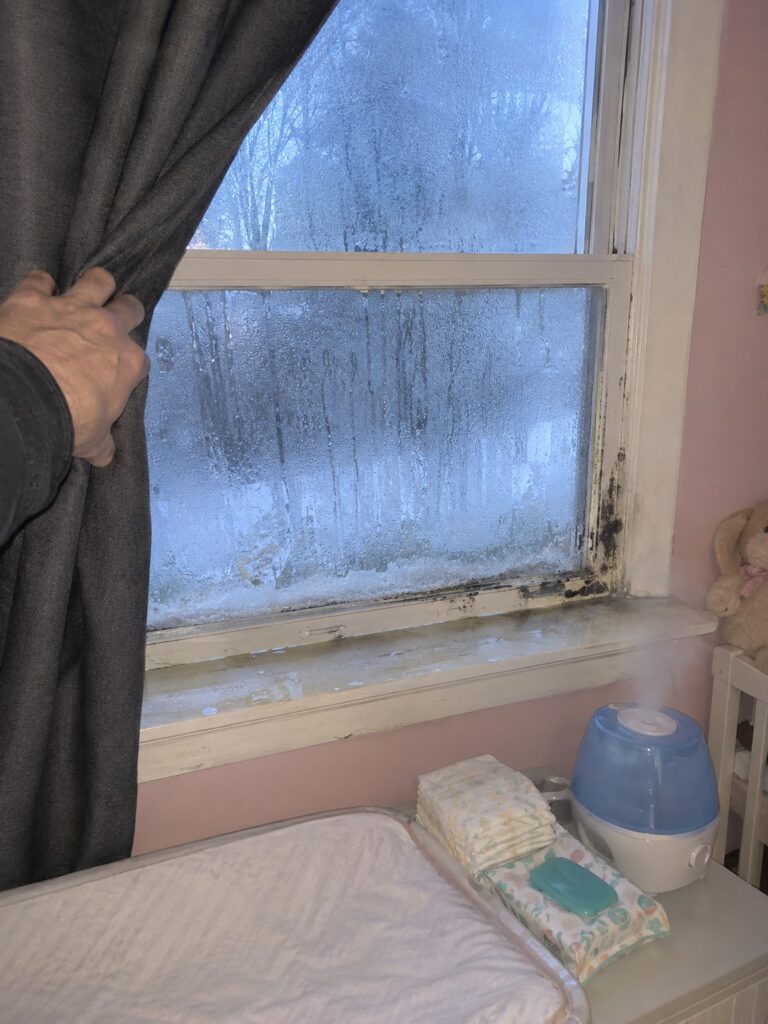
What we see in Fargo-Moorhead homes: mold on windows from condensation turned up in 40% of the 141 preliminary mold inspections we did from April 2025 to November 2026. When a family tells us about a new baby, the nursery window is one of the first places we check.
Lower-level bedrooms and the ground
Lars says that in Red River Valley homes the biggest source of winter moisture is usually the ground itself, not the humidifier. That is his experience from years of inspections, not a measured ranking. Many homes here have footings close to the water table, and water wicks up through the concrete into the basement air. A nursery in a lower-level bedroom, with cold windows set in the foundation wall, gets the worst of both. Our post on why mold grows in basements in Fargo homes explains the ground side.
Can mold affect babies?
Yes, mold can affect babies, and health agencies treat young children as more vulnerable than adults. The U.S. EPA notes that infants and children have less mature lungs and breathe faster, taking in more air relative to their body size than adults. The EPA lists coughing, wheezing, allergic reactions and asthma attacks among the effects of breathing in mold.
The CDC adds that early mold exposure may be linked to the development of asthma in some children, particularly children who may be genetically susceptible. People with asthma or mold allergies can have stronger reactions, according to the CDC, and people with weakened immune systems or chronic lung disease can get lung infections from mold.
None of this is a reason to panic over a few spots on a window. It is a reason to clean mold promptly, fix the moisture that feeds it and keep the nursery dry. If your baby has a cough, wheezing, a rash or trouble breathing, or you have questions about mold and your baby’s health, talk with your pediatrician. We don’t diagnose health problems; we find the mold and the moisture behind it. Our post on who is most at risk from mold covers infants, pregnancy and other sensitive groups in more depth.
Not sure whether the mold on the nursery window is a nuisance or a sign of a bigger moisture problem? A preliminary mold inspection measures the temperature, humidity and dew point, finds where the moisture is coming from and checks for hidden mold. Schedule a preliminary mold inspection.
What humidity should a baby’s room be in winter?
Lower than many parents expect. Health and building agencies give slightly different numbers, but they agree on the direction:
- The CDC says to keep humidity in your home as low as you can, no higher than 50%.
- The EPA’s humidifier guidance says not to humidify above 50% relative humidity.
- NDSU Extension recommends keeping it under 40% in winter, and notes that air below 30% can lead to dry skin and irritated nasal passages.
- In very cold weather the safe level drops further. The EPA publishes ASHRAE’s recommended maximum indoor humidity by outdoor temperature: 25% at 0°F and 20% at -10°F.
In a Fargo cold snap, the window glass sets the real limit. The EPA and Mayo Clinic both point to a hygrometer, an inexpensive humidity gauge, for checking the level. Put one in the nursery, away from the humidifier, and let the window be the final judge. If the nursery window is wet, the humidity is too high for the weather outside.
Using a humidifier in the nursery safely
Many parents run a humidifier for a baby’s dry skin or stuffy nose. If you’re not sure your baby needs one, ask your pediatrician. If you do use one, the EPA’s guidance on home humidifiers comes down to a few habits:
- Don’t let the room get damp. If water condenses on windows, walls or pictures, the EPA says to move the humidifier, lower its setting or use it less. Keep it away from the window and the curtains.
- Empty, wipe and refill it every day. The EPA recommends emptying the tank, wiping all surfaces dry and refilling portable humidifiers daily.
- Clean it every third day, following the maker’s instructions, and rinse it well.
- Use low-mineral water. The EPA suggests water labeled distilled, which cuts down the minerals that end up as white dust on furniture.
- Skip hot-steam units around little ones. The EPA warns that steam vaporizers can cause burns and should be kept out of children’s reach, and Mayo Clinic advises against buying that type if you have children.
Setting up the nursery so the window stays dry
- Open the curtains or blinds during the day so the room’s heat reaches the glass, and close them for naps and at night.
- Keep the wall under the window clear. A changing table, crib or dresser against it blocks the heat register and the air that keeps the glass warmer. The EPA recommends using fans and moving furniture away from wall corners to improve air circulation.
- Keep furniture away from window cords, too. The U.S. Consumer Product Safety Commission advises moving cribs, beds, furniture and toys away from windows and window covering cords, preferably to another wall, and calls cordless window coverings the safest option when young children are present. A changing table on another wall is better for safety and for the window.
- Keep the glass warmer. Storm windows and caulking keep the inside glass warmer and reduce condensation, according to the EPA. NDSU Extension also suggests window plastic.
- Lower the moisture in the whole house. Run the bathroom fan during showers and the range hood when you cook, vent the dryer outside, and keep the HRV running and maintained if your home has one; see our post on HRV and ERV maintenance. For more on the basics, see why windows get condensation in the fall and winter, and our guide to window condensation mold.
Found mold in baby’s room? How to clean it
Small areas of mold on hard window surfaces are usually a homeowner job. The EPA says an area smaller than about 10 square feet can generally be handled yourself.
- Take the baby out of the room while you work. If you have asthma or allergies, ask someone else to do the cleaning.
- Dry the window, open the sash if it opens, and vacuum loose debris from the track, ideally with a HEPA vacuum.
- Scrub the glass, frame, track and sill with detergent and water, then wipe them dry.
- Wash curtains and other fabric that touched the wet glass. Soft or rotted wood, crumbling caulk and moldy drywall below the window may need to be replaced.
- Fix the moisture. If you only clean, the mold will be back in a few weeks.
We don’t recommend bleach for this. Our post on using bleach and vinegar on mold explains why.
When to call for a mold inspection
A little mold on one window is common and usually manageable. Call for a closer look when:
- The mold comes back within weeks of cleaning, even with the humidifier turned down.
- Every window in the house sweats, not just the nursery. That points to a whole-house moisture source.
- The nursery is a lower-level bedroom with cold windows in the foundation wall.
- There is a musty odor, which the EPA lists as a sign of hidden mold.
- The drywall below the window is stained, soft or bubbling, or the wood frame is soft.
- The home has had water damage and a baby is on the way.
When we check a nursery, we measure instead of guessing. We record the room’s temperature, relative humidity and dew point, and we use thermal imaging to read the surface temperature of the glass, the frame and the wall below it. A surface at or below the dew point will collect water, and the thermal camera shows exactly where. Moisture meters tell us whether the sill, drywall and framing are actually wet, and then we follow the moisture back to its source. We add air or surface samples only when they answer a real question, such as whether mold is hidden in a wall. The CDC doesn’t recommend routine mold testing, and our guide to mold testing options explains when testing helps.
Experience you can check
Nordic Inspections has inspected homes in Fargo-Moorhead, North Dakota and Minnesota since 2010. Our mold work is led by Lars Knobloch, a Council-certified Indoor Environmentalist (ACAC CIE) and ASHI Certified Inspector who is also a certified radon measurement professional and radon mitigation specialist. Lars has provided litigation support on building defects and environmental problems, and our mold samples are analyzed by EMSL Analytical.
Nordic doesn’t remove mold, so our findings have no cleanup to sell. Our mold inspection and testing page explains how an inspection works, and the Mold Resource Center brings all of our mold articles together.
Frequently asked questions
Can babies get sick from mold?
Some can. The EPA notes that babies’ lungs are less mature and that they breathe more air for their size than adults, and mold can cause coughing, wheezing and allergic reactions in sensitive people. Talk with your pediatrician about any symptoms, and keep the nursery clean and dry.
Is black mold in my baby’s room dangerous?
The color doesn’t tell you much; many common molds look black. The CDC’s advice for mold you can see or smell is to remove it. Clean small areas promptly, fix the moisture, and talk with your pediatrician if you’re worried about your baby’s health.
Should my baby sleep in the nursery after I find mold?
Keep the baby out while you clean and until the room is dry and aired out. If the mold keeps coming back, covers more than a small area, or you smell mold but can’t find it, have the room checked before the baby moves back in.
What humidity should a baby’s room be in winter?
No higher than 50%, according to the CDC and the EPA, and under 40% in winter, according to NDSU Extension. On the coldest days go lower: the EPA’s ASHRAE table suggests 25% at 0°F outdoors. If the window is wet, the humidity is too high.
Is a humidifier in a baby’s room safe?
It can be, if it’s kept clean and the room doesn’t get damp. The EPA recommends emptying and refilling portable units daily, cleaning them every third day and keeping steam vaporizers out of children’s reach. Ask your pediatrician whether your baby needs one.
Should I test the mold in my baby’s room?
Usually not. Visible mold should be cleaned and its moisture source fixed. The CDC doesn’t recommend routine mold testing, and the EPA says sampling is usually unnecessary when mold growth is visible. Testing makes sense when you suspect hidden mold, for example a musty odor or stained drywall.
Sources
- U.S. EPA, Mold Exposure and Respiratory Conditions in Young Children
- CDC, Mold
- U.S. EPA, Use and Care of Home Humidifiers
- Mayo Clinic, Humidifiers: Ease skin, breathing symptoms
- U.S. EPA, What are the main ways to control moisture in your home?
- U.S. EPA, A Brief Guide to Mold, Moisture and Your Home
- NDSU Extension, Eliminate Condensation on Windows
- W. J. Angell and W. W. Olson, University of Minnesota Extension Service, Moisture Sources Associated with Potential Damage in Cold Climate Housing (1988)
- U.S. Consumer Product Safety Commission, Window Covering Cords