

More homes in Fargo-Moorhead have spray foam insulation sprayed directly onto the underside of the roof. It is common in finished attics, bonus rooms, cathedral ceilings and some newer homes. Done right, a spray foam roof deck can make a tight, comfortable home. Done wrong, it can trap moisture against the roof sheathing, and it can change what your shingle warranty covers. When we find it during a home inspection, we point it out so buyers and homeowners know what questions to ask.
This guide explains what a spray foam roof deck is, what the building code requires, how it affects asphalt shingle warranties, what the finding means in an inspection report, and how to keep the roof healthy.
What a spray foam roof deck is
Most attics in our area are vented. Insulation sits on the attic floor, and air flows in at the soffits and out near the ridge to keep the roof deck cold and dry. You can read more in our guide to attic ventilation in Fargo-Moorhead.
A spray foam roof deck works the other way. Foam is sprayed onto the underside of the roof sheathing, the vents are closed, and the attic becomes an unvented space inside the home’s insulated envelope. Builders and owners choose it to bring ductwork inside the insulation, to air-seal complicated roof lines, or to insulate rooms built into the roof.
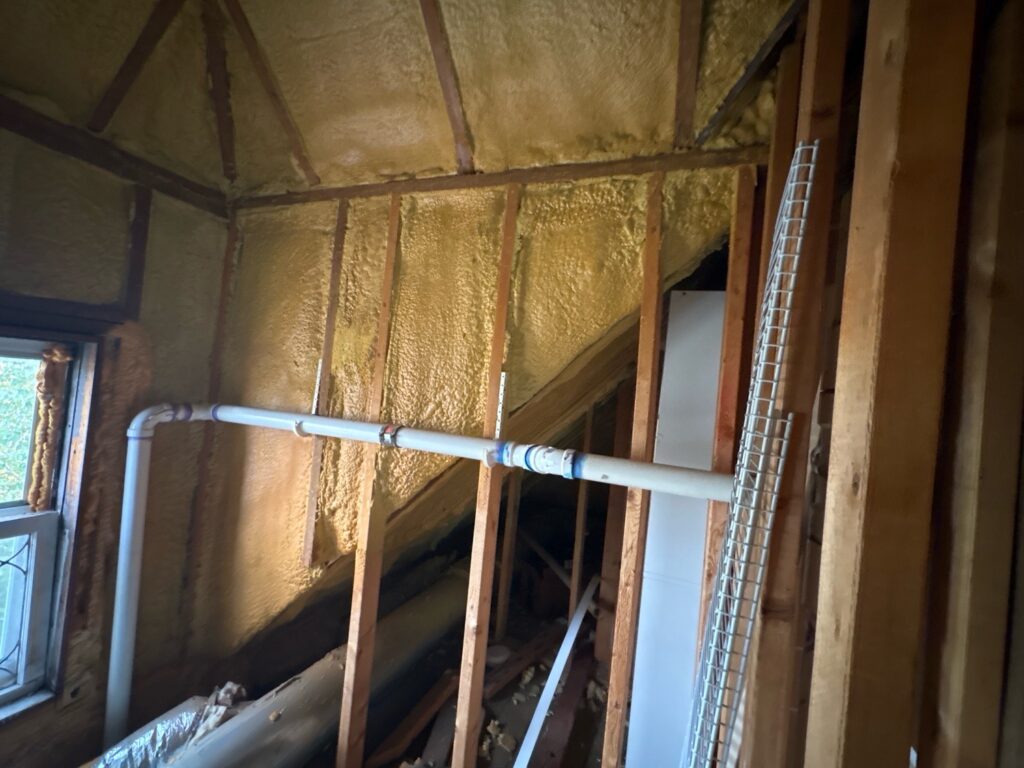
There are two main types of spray foam:
- Closed-cell foam is dense and more or less vapor-impermeable.
- Open-cell foam is lighter and vapor-permeable, so water vapor can pass through it.
That difference matters a lot in a cold climate.
What the building code requires
The International Residential Code (Section R806.5), which both North Dakota and Minnesota base their residential codes on, allows unvented attics only when the whole assembly is built to control condensation. Among the main conditions:
- The unvented attic must be completely within the building’s thermal envelope.
- No interior Class I vapor retarder (such as polyethylene sheeting) on the attic floor.
- In Climate Zones 5 through 8, which include our region, the air-impermeable insulation must be a Class II vapor retarder or have a Class III vapor retarder coating or covering in direct contact with it.
- Where only air-impermeable insulation such as spray foam is used, it must be in direct contact with the underside of the roof sheathing.
- If fiberglass or cellulose is added below the foam, the foam layer must meet a minimum R-value for the climate zone. In Duluth, for example, the city’s handout calls for at least R-30 of air-impermeable insulation under the Minnesota Residential Code.
Simply closing the vents and spraying some foam is not enough. Foam left exposed in a room or a used attic also needs the thermal or ignition barrier the code requires.
Why moisture is the big concern here
In winter, the air inside a home is warm and carries moisture. In an unvented roof, the only thing keeping that moisture away from the cold roof sheathing is the foam. Green Building Advisor’s Martin Holladay notes that in Climate Zone 5 and colder, water vapor in indoor air can diffuse through open-cell spray foam on the underside of roof sheathing, and researchers have found damp sheathing in open-cell foam attics. He recommends against open-cell foam on the underside of roof sheathing in any climate. Where open-cell foam is already in place, one fix he describes is adding a vapor retarder on the interior side of the foam.
Problems also come from gaps where the foam pulled away, thin spots at the eaves, vents that were left open, and roof leaks that the foam hides from view.
Does spray foam void a shingle warranty?
It depends on the shingle manufacturer and the warranty, so check the written warranty for the shingles on the house. Two examples:
- GAF says sprayed foam does not void its shingle limited warranty against manufacturing defects. However, damage attributable to spray foam applied directly to the roof deck, or to a lack of ventilation, is excluded. For new construction and tear-off reroofing, GAF recommends a ventilated nail base with soffit and ridge vents so the shingles sit on a ventilated surface.
- CertainTeed, in a 2004 technical bulletin, said its shingle warranty stays in force over insulation installed beneath the deck, with or without ventilation, on slopes greater than 2:12. It placed responsibility for proper design on the design professional and excluded damage from deck deterioration and mold.
Manufacturers update these policies, so ask the roofer or the manufacturer for the current terms before you reroof or buy.
What this finding means in an inspection report
When we find spray foam on the roof deck during an inspection, we note it in the inspection report and explain that some asphalt shingle manufacturer warranties are voided or limited when the roof deck is spray foamed. We recommend having it evaluated as needed. On a new home, we recommend asking the builder whether the shingle manufacturer’s warranty allows a spray foamed roof deck.
We also look for signs of trouble: foam pulled away from the sheathing, gaps at the eaves and ridge, open vents in an attic meant to be unvented, stains, damp or darkened wood, mold, rusted nails and exposed foam in living space. Foam hides the sheathing and roof nails from view, so we cannot confirm the condition of the wood behind it or the foam thickness everywhere. Thermal imaging can help find gaps and wet areas.
What to do if your home has a spray foam roof deck
- Get the paperwork. Ask for the insulation product, whether it is open- or closed-cell, the thickness, and any permit or inspection records.
- Check the shingle warranty. Find out which shingles are on the roof and what that manufacturer says about spray foam decks.
- Tell your roofer before reroofing. The roofer should know the deck is foamed, check the sheathing as the old roof comes off, and follow the manufacturer’s guidance.
- Have damp signs evaluated. If you see moisture, mold or roof stains, have an insulation contractor or building science professional evaluate the assembly.
How to keep a spray foam roof healthy
- Keep indoor humidity reasonable in winter and run bath and kitchen fans.
- Fix roof leaks quickly, because foam can hide a leak for a long time.
- Do not reopen or partly block vents. An attic should be either vented or unvented by design, not a mix.
- Look in the attic once a year for gaps, stains or odors.
Related reading: knee wall attic insulation and ventilation and frost in the attic.
Spray foam roof deck: common questions
Is open-cell or closed-cell foam better under a roof deck?
In cold climates like ours, closed-cell foam resists water vapor much better. Open-cell foam on a roof deck carries more moisture risk unless a vapor retarder is added on its interior side.
Can a roof be replaced over a spray foamed deck?
Yes. Shingles can be replaced, but the roofer should know about the foam, inspect the sheathing and follow the shingle manufacturer’s requirements, which may include a ventilated nail base.
Should I remove spray foam from my roof deck?
Not usually. A properly installed, code-compliant assembly can perform well. If there are signs of moisture or damage, have it evaluated before deciding.
Will my home inspector check the spray foam?
We look at what is visible and accessible: coverage, gaps, venting and signs of moisture. We cannot see behind the foam or measure it everywhere. Learn more about our home inspections.
Sources
- Under Deck Sprayed-In-Place Foam Insulation (TAB-R-135), GAF technical bulletin
- Fiber Glass Shingles Applied Over Unventilated/Insulated Roof Decks (R-201B), CertainTeed technical bulletin, 2004
- Residential Unvented Attic Assemblies, City of Duluth, Minnesota
- International Residential Code, Chapter 8, Section R806.5, International Code Council
- Why Are Attics Insulated With Open-Cell Spray Foam So Damp?, Martin Holladay, Green Building Advisor, Efficiency Vermont Better Buildings by Design, 2018
- Unvented Roofs and Shingle Warranties, Journal of Light Construction