

Deck maintenance is easy to put off when the boards look fine from the patio door. But most serious deck problems start where you can’t see them: behind the ledger board, at the footings and on the fasteners holding it all together.
This guide covers the deck findings we see most often in Fargo-Moorhead, why they happen here, what they mean in an inspection report, and what you can do to keep a deck safe and solid for years.
Why decks wear out faster in our climate
In the Red River Valley a deck takes rain, snow that sits for months, spring melt and deep frost. Wood soaks up water and dries out again, over and over, which opens checks, wears down the finish and gives decay a foothold where wood stays damp.
Frost is the other big factor. Clay soils in our area hold water, and the ground freezes deep. Minnesota puts Clay County in its 5-foot frost zone for footings. Fargo’s deck permit handout notes that the city does not currently require footings for uncovered decks attached to the house to go below the 4½-foot frost depth, though it encourages deeper footings. Shallow footings are one reason we often see decks that have heaved or settled.
Ledger board flashing
The ledger board is the board bolted to the house that carries one side of the deck. It is the single most important connection on an attached deck. When water gets behind it, it can rot both the ledger and the house’s rim joist, and the bolts can lose their grip.
That is why flashing matters. Flashing is a strip of corrosion-resistant metal or approved membrane that sheds water over the top of the ledger and away from the house. The American Wood Council’s deck construction guide states that “approved corrosion resistant flashing is required at any ledger board connection,” and Fargo’s deck handout says the same: “The ledger board shall be flashed.”
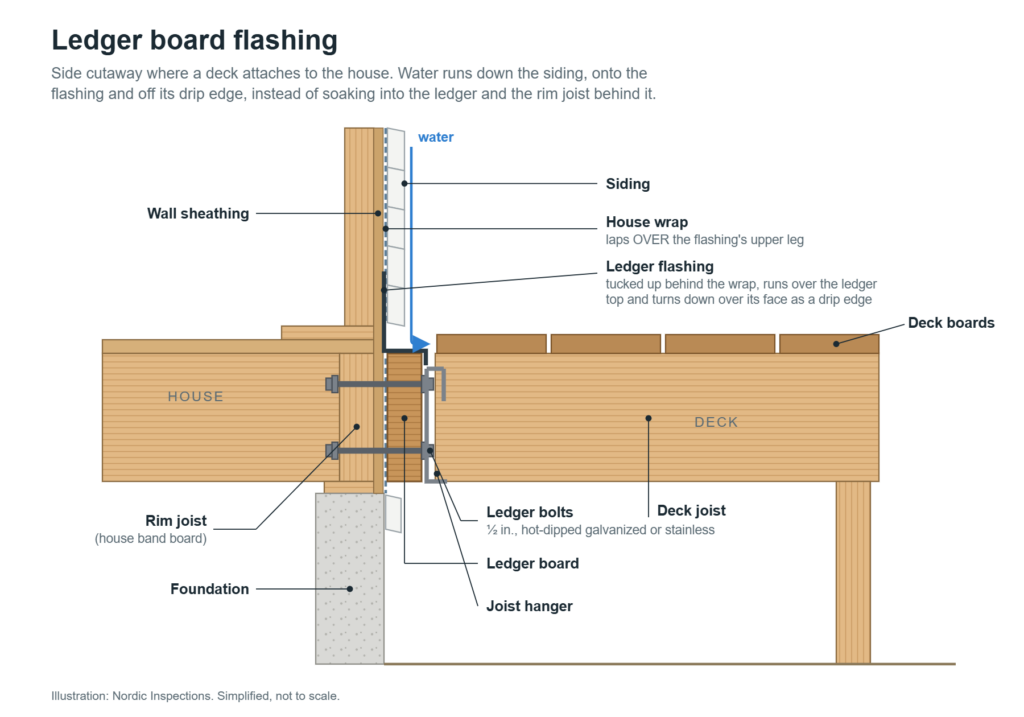
Signs of trouble at the ledger include:
- No flashing visible above the ledger.
- Dark stains, soft wood or rot on the ledger or the rim joist behind it.
- Gaps between the ledger and the house, or rusty, loose bolts.
- A ledger attached to brick or stone veneer, which the deck guide prohibits.
When flashing cannot be added without removing the deck boards and siding, sealing the joint is a less effective alternative that buys time. The better long-term fix is to have a deck contractor install proper flashing and check the wood behind it.
Rusty or wrong fasteners
Modern treated lumber uses copper-based preservatives, which corrode plain steel. That is why deck guides call for fasteners that resist corrosion. The American Wood Council guide requires that “all screws, bolts, and nails shall be hot-dipped galvanized, stainless steel, silicon bronze or copper,” and joist hangers and other hardware must be galvanized or stainless steel. Fargo’s handout adds that deck screws cannot stand in for structural fasteners, because they are too brittle and usually too short.
Rust streaks below nail heads, flaking hangers and screws that have lost their heads are signs that fasteners are wearing out. Rusted fasteners in the deck boards are usually a maintenance issue. Rusted joist hangers, ledger bolts and post connectors are a structural issue, because they hold the deck up.
Settling, heaving and sway
A deck that has settled or tilted usually points to the footings. A shallow footing can heave when the ground freezes and drop back unevenly in spring, and a footing on soft soil can sink. Signs include a sloping deck, gaps at the ledger and stairs pulling away from the landing.
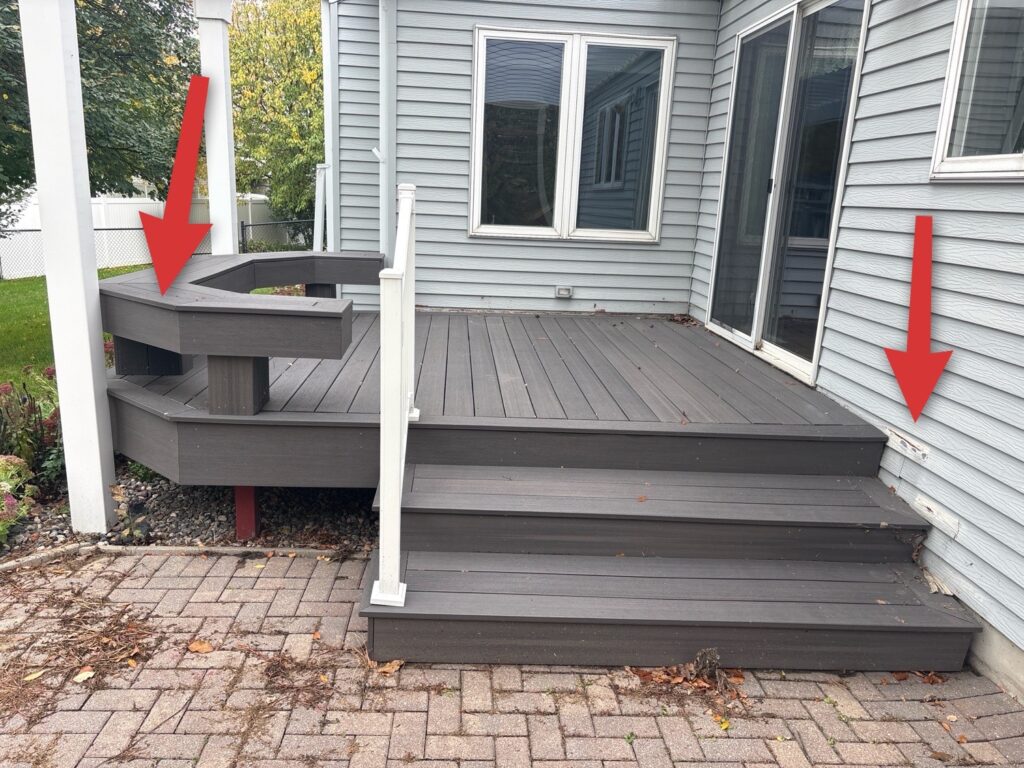
A deck that sways when you walk on it is not braced well enough. The American Wood Council guide calls for diagonal bracing on decks more than 2 feet above grade, “both parallel and perpendicular to the beam at each post,” unless the deck is designed to get its stability from the house in another way. Adding bracing is often a simple fix that makes a big difference.
A deck that has settled can often be raised and leveled, with new or deeper footings where needed. That work should be done by a qualified deck contractor, and in Fargo, a building permit is required before deck work begins.
Moss, algae and mildew
Shaded decks that stay damp grow moss, algae and mildew, especially on north sides and under trees. Beyond the look, growth makes boards slippery and holds moisture against the wood, which speeds up decay.
A Journal of Light Construction deck cleaning guide suggests a mild solution of about 1 cup of household bleach per gallon of water for mold and mildew on treated wood, or an oxygen bleach cleaner, which is easier on nearby plants. Pre-rinse the deck, protect plants and siding, let the cleaner work, then rinse well. If you use a pressure washer, keep the pressure low (the guide suggests 500 to 600 psi for treated pine), use a fan tip 12 to 18 inches from the surface and keep it moving so you don’t gouge the wood.
To keep it from coming back, let in sun and air, sweep off leaves and keep the deck finished. Our post on roof moss and algae in Fargo-Moorhead explains why shaded surfaces grow it in the first place.
Rooftop decks and exposed membranes
Some decks sit over living space on a waterproof membrane. Many roofing membranes are not made to be walked on, and foot traffic, grills and furniture can puncture them, which means a leak into the room below. Unless the membrane is rated as a walking surface, it should be covered with a protective surface such as wood or rubber decking.
What these findings mean in an inspection report
When we find deck issues during an inspection, we note what we saw and where. Missing ledger flashing, settling, sway, rusted structural connectors and rot are recommended for repair by a qualified deck contractor, because they affect how the deck carries its load. Moss, mildew and worn finish are noted as maintenance items.
We cannot see inside a ledger connection or dig up a footing, so when the signs point to hidden damage, further evaluation is the next step. Railings and stairs are a separate safety topic; our post on deck railing safety covers guardrail and handrail requirements.
Deck maintenance checklist
- Each spring, look under the deck at the ledger, joists, beams and post connectors for rot, rust and loose bolts.
- Probe the ledger and post bases with a screwdriver. Soft wood needs attention.
- Clean the deck surface at least once a year and re-apply a finish when water no longer beads up.
- Keep soil, mulch and snow piles from sitting against posts and the house side of the deck.
- Make sure gutters and downspouts do not dump water onto the deck or the ledger. See clogged and leaking gutters in Fargo-Moorhead.
- Add your deck to the fall walk-around before winter. Our Nordic Fall Home Checkup is an easy way to get a second set of eyes on it.
Deck maintenance: common questions
Can I add flashing to an existing deck?
Often, yes. It usually means removing the deck boards next to the house so the flashing can lap correctly under the siding. A deck contractor can also check the wood behind it.
Are rusty deck screws dangerous?
Rusty screws in deck boards are mostly a maintenance issue. Rust on joist hangers, ledger bolts or post connectors is more serious because those parts hold the deck up.
Why is my deck sinking or tilting?
The most common causes are footings that are too shallow, which can heave with frost, or footings on soft soil. A contractor can raise the deck and add proper footings.
What is the best way to remove moss from a deck?
Use a deck cleaner or a mild bleach or oxygen bleach solution with a stiff brush, then rinse. Go easy with a pressure washer, and improve sun and airflow so it doesn’t come back.
Sources
- American Wood Council. Prescriptive Residential Wood Deck Construction Guide (DCA 6) (as distributed by a local building department).
- City of Fargo Inspections. Residential Deck Handout.
- Minnesota Rules, part 1303.1600. Footing Depth for Frost Protection.
- Mark Clement, Journal of Light Construction. Cleaning Wood Decks.
- Rob Corbo, Journal of Light Construction. Waterproofing a Rooftop Deck.