
A mold air test in a home usually means a spore trap sample. In a spore trap test, a small calibrated pump pulls a measured amount of air through a sealed cassette for a few minutes, a laboratory counts the mold spores it caught under a microscope, and the indoor results are compared with an outdoor sample taken the same day. Done as part of a real inspection, a mold air test can confirm a hidden problem and show where to look. Done on its own, it can mislead. This guide walks through how a spore trap air sample is taken, what the lab actually counts, what the test can and can’t tell you, and when it’s worth doing.
Nordic Inspections · Fargo-Moorhead
Worried about mold in your home?
Tell us what you’re seeing, smelling or worried about and we’ll recommend the right next step. A preliminary mold inspection finds the moisture and the growth first, then adds air, surface or mycotoxin sampling only where it answers a real question.
Questions first? Call (701) 566-1446
The short answer: a mold air test shows what was floating in the air during the few minutes the pump ran, and whether the indoor air looks different from the outdoor air that day. It can’t tell you where the mold is, how much there is, or whether the air is safe for a particular person. That’s why the moisture investigation comes first and the air sample second.
What a mold air test is (and why it’s called a spore trap)
Industrial hygienists call this a direct examination sample. AIHA, the professional association for industrial hygienists, notes it is commonly called a “nonviable,” “spore trap” or “total spore count” sample. It is collected with an inertial impactor: a small plastic cassette, sold under names such as Air-O-Cell, Allergenco-D and Cyclex-D, with a sticky glass slide inside.
“Nonviable” doesn’t mean the spores are dead. It means the lab doesn’t grow them. It counts and identifies the spores it can see on the slide, living or dead, and reports them as spores per cubic meter of air. That is different from a culture (viable) air sample, where spores land on a growth medium and the lab counts the colonies that grow. AIHA notes culture results usually take seven to 14 days, while spore trap results usually come back in 24 to 72 hours.
How a spore trap air sample is taken, step by step
- The inspection comes first. Moisture readings, odors and any visible growth decide where samples go. Air sampling without that look around answers very little.
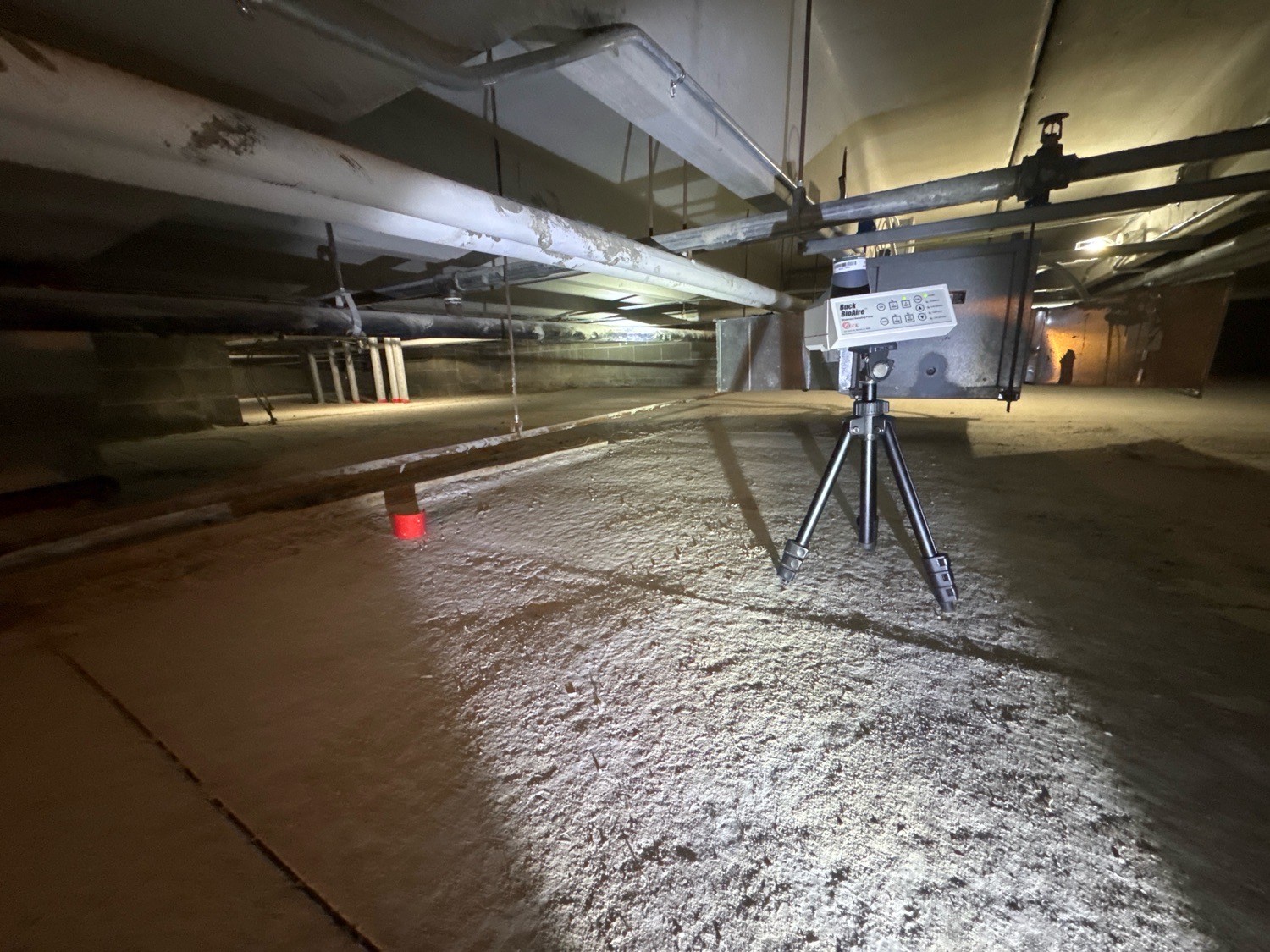
- The pump is calibrated. For Air-O-Cell cassettes, the Wisconsin State Laboratory of Hygiene calls for a flow of 15 liters per minute. Above 20 liters per minute, large spores can bounce off the slide; below 10, small spores aren’t collected as well.
- Air runs through the cassette. The pump pulls air through a narrow slit in the cassette, and spores and particles hit the sticky slide behind it.
- The pump runs for a set time. AIHA describes a typical spore trap sample as five to 15 minutes. Times are kept shorter where spore levels may be high, so the slide isn’t overloaded. The time and the total liters sampled are recorded.
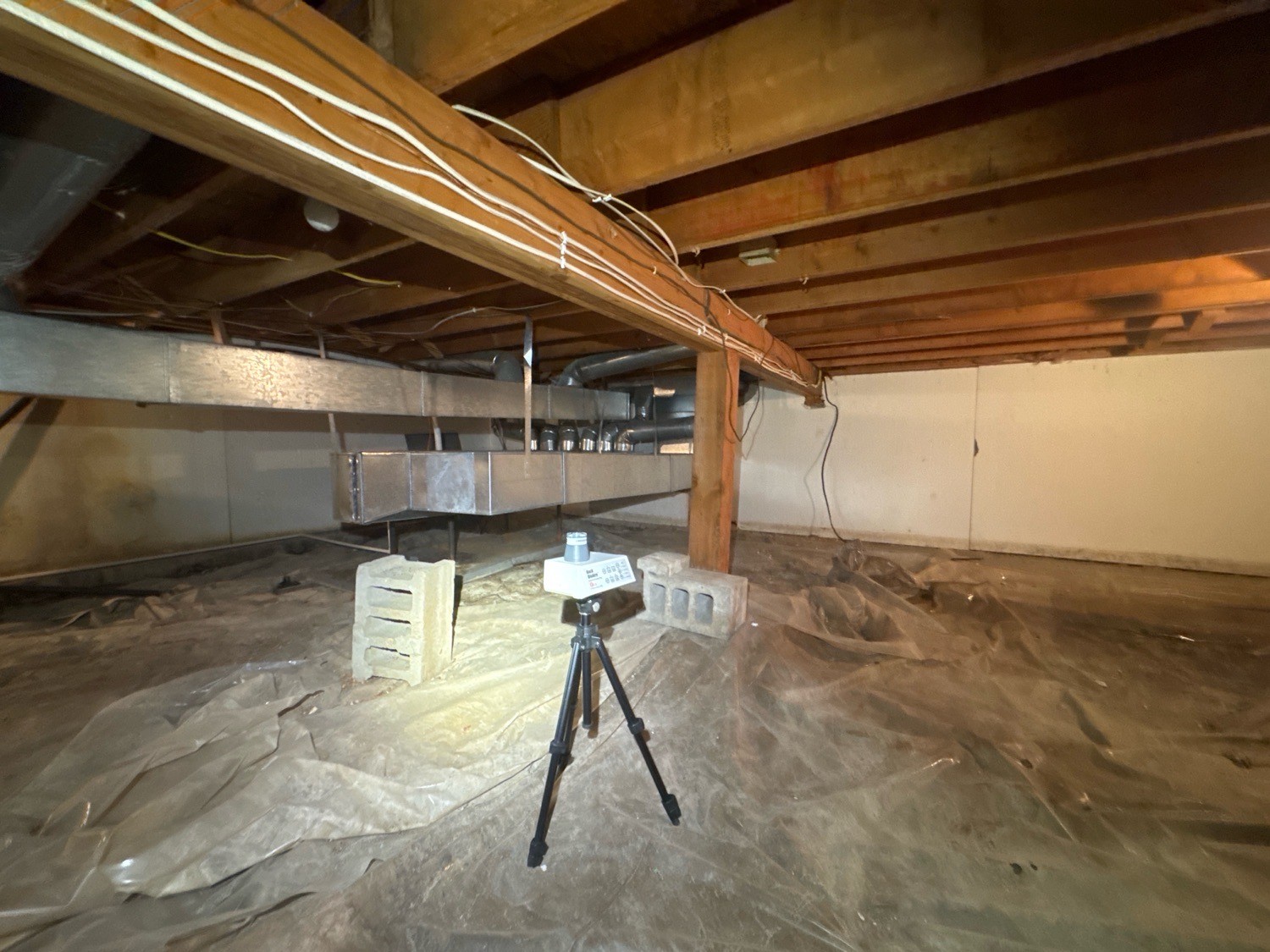
- More than one sample is taken. Each area of concern gets its own sample, and an outdoor sample is taken on the same visit as the reference. Sometimes the weather makes an outdoor sample impossible or not worth taking: AIHA advises against spore trap sampling in freezing temperatures, and in our experience an outdoor sample in a Fargo-Moorhead winter usually comes back nearly clean. When that happens, the client decides whether to take it, and we recommend a second indoor sample in a room that isn’t suspected. A single sample on its own has nothing to be compared against.
- The cassettes are sealed and sent to the lab. Each one is capped, labeled and listed on a chain of custody form. Nordic’s samples are analyzed by EMSL Analytical.
Why the outdoor sample matters
There is no “safe” number for mold spores in indoor air, so an air sample is read by comparison. AIHA explains that both spore trap and culture sampling typically compare indoor and outdoor samples to see whether fungal levels are significantly elevated indoors. Outdoor air always has mold spores in it. What matters is whether the indoor air looks like the outdoor air that day, with similar types in similar or lower numbers, or whether it shows something the outdoor air doesn’t.
Two patterns get attention. One is indoor counts well above outdoor counts for the same types. The other is mold types that are common in wet building materials but uncommon outdoors showing up indoors. The control room adds a second comparison: if the area of concern looks different from both the outdoor air and an unaffected room in the same house, that points toward a local source. When the weather rules out a useful outdoor sample, as it often does in a Fargo-Moorhead winter, that unaffected room becomes the main comparison. Our guide on how to read mold test results walks through these comparisons line by line.
What the lab actually counts
An analyst looks at the slide under a microscope and identifies spores by their shape, size and color. Results are reported by type and as spores per cubic meter of air. Some types can’t be told apart this way. AIHA states plainly that Aspergillus spores “cannot be reliably distinguished” from Penicillium spores in these samples, so labs report them together as one group, often written “Penicillium/Aspergillus-like.” AIHA adds that direct examination results can’t be used for reliable species identification. A spore trap can tell you a group was present. It can’t tell you which species.
Not sure whether an air test would answer your question? A preliminary mold inspection starts with the moisture and only samples where an air test answers a real question. Schedule a preliminary mold inspection.
What a mold air test can’t tell you
This is the part most online ads leave out, and it’s the part that matters most when you’re deciding what to do.
- It can’t tell you whether the air is safe for you. AIHA’s guidance is direct: air sampling for mold spores “does not and cannot evaluate potential health risks.” NIOSH says there are no health-based standards for mold in indoor air and that spore counts from short-term samples cannot be interpreted in relation to health risks.
- There is no pass or fail number. The EPA says there are no EPA regulations or standards for airborne mold, and the World Health Organization concluded that no quantitative health-based guideline values can be recommended for mold levels. The CDC says there are no set standards for what is an acceptable quantity of mold in a home.
- It’s a snapshot. AIHA notes that spore levels in one room can differ as much as 10,000-fold at different times of day, that the error of a single result is generally thought to be between 30 and 200 percent, and that a single sample can’t be considered representative of an area. Building scientist Joseph Lstiburek and his co-authors at Building Science Corporation described an air sample as a “snapshot” of one location at one time.
- It can’t tell you where the mold is or how much there is. A high count in a basement says something is releasing spores there. It doesn’t say which wall, how far it extends or what’s causing it. Finding that is the job of the inspection and moisture readings.
- A “normal” result doesn’t clear a house. NIOSH notes that short-term results, especially negative findings, may not represent actual exposures. Mold sealed inside a wall cavity may release little into the room while the pump is running. That’s when a wall cavity sample, taken through a small hole in the drywall, can help.
Is a mold air test accurate?
It’s accurate for what it measures: the spores that landed on the slide during those minutes, counted by a trained analyst. It is not precise enough to be read on its own. Because spore levels swing so much from hour to hour, two samples taken an hour apart can look quite different. AIHA’s answer is the one we follow: without an informed inspection, air sampling alone can’t support definitive conclusions. An air sample is a tool that supports what the inspection finds, not a verdict.
When a mold air test is worth it, and when it isn’t
Often worth it:
- A musty odor with no visible mold, where the question is whether there is hidden growth.
- After a leak or flood, to check whether materials that got wet are now releasing spores into the room.
- To compare rooms, for example a finished basement against the upstairs living area.
- After mold remediation, as part of post mold remediation testing that checks the cleanup worked.
- When you’re buying a house with mold concerns and need to understand how far a problem goes.
Usually not worth it:
- When you can already see mold. The EPA says that in most cases, if visible mold growth is present, sampling is unnecessary. The next step is finding the moisture and planning the cleanup. AIHA says the same: when growth is visible, indoor sampling often isn’t needed at all.
- “Just to see what’s in the air.” AIHA says air sampling cannot be used for that kind of project, because without a question to answer, there is no way to read the result.
- To find out whether mold is making someone sick. No air test can answer that. Our guide to mold exposure symptoms explains what health agencies say, and your physician is the right person for that question.
The CDC goes further: it does not recommend mold testing. Its advice is to remove mold you can see or smell and fix the moisture. NIOSH has found that a thorough visual inspection and musty odors are more reliable than air sampling for finding problems. That matches our experience: the moisture investigation does most of the work, and the air sample answers the questions the inspection can’t.
How spore trap air sampling compares with other mold tests
| Test | What it samples | Best for | Main limit |
|---|---|---|---|
| Spore trap air sample | Spores in a measured volume of room air | Comparing rooms with each other and with outdoors | A snapshot; groups some look-alike types together |
| Wall cavity air sample | Air drawn from inside a wall | Checking a wall without opening it | Says little about how much of the wall is affected |
| Tape lift or swab | A visible spot or stain | Confirming whether a stain is mold | Only tells you about the spot sampled |
| ERMI or HERTSMI-2 dust test | Settled dust, by DNA | Research studies | The EPA says ERMI isn’t validated for public use |
| Mycotoxin air test | Mold toxins in collected air | Adding detail inside an inspection | No regulatory limits; not a medical test |
| Petri dish kit | Whatever settles on an open dish | Not recommended | No measured air volume, no outdoor comparison |
For the full picture, see Mold Testing Options Explained, our deep dive on ERMI and HERTSMI-2 dust tests, and how our mycotoxin air testing works. The Mold Resource Center has a card for each test.
Our experience
Nordic Inspections has served Fargo-Moorhead and the surrounding areas of North Dakota and Minnesota since 2010. Our mold inspections are led by Lars Knobloch, a Council-certified Indoor Environmentalist (ACAC CIE) and ASHI Certified Inspector, who also holds radon measurement and mitigation certifications and has provided litigation support on building defects and environmental problems. Our air samples are analyzed by EMSL Analytical. We collect spore trap samples in the areas of concern and outdoors, adding a room that isn’t suspected when the weather rules out a useful outdoor sample, and we read the results next to the moisture readings and what we saw in the house, never on their own. Learn more about our mold inspection and testing services, or why we prefer sampling the whole home, not just the area you see.
Mold air test: common questions
How long does a mold air test take?
Each spore trap sample usually runs about five to 15 minutes, according to AIHA. A full visit takes longer because the inspection and moisture readings come first and several locations are sampled. Spore trap results usually come back from the lab in 24 to 72 hours.
How does a mold air test work?
A calibrated pump pulls air through a small cassette at a set flow rate. Spores in the air strike a sticky slide inside. A lab counts and identifies them under a microscope and reports spores per cubic meter of air, and the indoor results are compared with an outdoor sample, or with a room that isn’t suspected when the weather rules out an outdoor sample.
Should I test the air if I can already see mold?
Usually not. The EPA says that in most cases, if visible mold growth is present, sampling is unnecessary. Finding the moisture source and planning a proper cleanup matters more than a spore count.
Are mold air test kits from the store accurate?
Most store kits are settle plates: an open dish that catches whatever happens to fall on it. They don’t measure a known volume of air, there’s no outdoor comparison, and almost every dish grows something. A spore trap sample with a calibrated pump and an outdoor reference is a different kind of test.
Can a mold air test find mold inside a wall?
Not reliably. A room sample may not pick up growth sealed inside a wall cavity, which is why a normal result doesn’t rule it out. A wall cavity sample, drawn through a small hole, samples the air inside the wall itself.
Do mold air test results tell me whether mold is making me sick?
No. AIHA states that air sampling for mold spores cannot evaluate potential health risks, and there are no health-based exposure limits for mold. If you have symptoms, talk with your physician.
Sources
- AIHA, FAQs About Spore Trap Air Sampling for Mold for Direct Examination (approved May 2019; hosted by the Navy and Marine Corps Force Health Protection Command)
- U.S. EPA, Mold Testing or Sampling
- CDC, About Mold
- NIOSH, Mold, Testing, and Remediation
- World Health Organization, WHO Guidelines for Indoor Air Quality: Dampness and Mould (2009)
- Wisconsin State Laboratory of Hygiene, Air-O-Cell Sample Collection
- Lstiburek, Brennan and Yost, Building Science Corporation, RR-0209: Mold Testing (2002)